by Guest Contributor | Sep 12, 2016 | Opinion
Basic Income Québec (RBQ) and the French Movement for a Basic Income (MFRB) had been preparing for the World Social Forum (WSF) event for almost a year. Their efforts paid off – the activities organized by the France-Québec team were an unmitigated success. For the first time ever, basic income achieved prominence at WSF, reflecting the growing worldwide interest in the idea.
A successful opening march with basic income robots that did not go unnoticed
The six members of the MFRB delegation teamed up with their counterparts of RBQ in order to organize several initiatives centered on basic income at the WSF in Montreal.
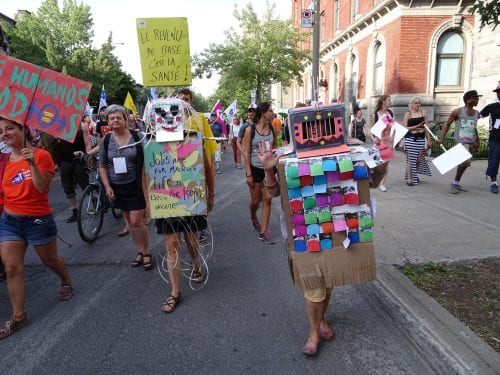
A wild workshop, a prelude to the Create-a-thon planned for Tuesday, August 9th, led to the creation of two robots (a concept developed by the MFRB local group of Lyon) along with signs and ponchos for the opening march taking place that day in Montreal, from Lafontaine Park to the Place des Arts that attracted about 15,000 people.
Marcus Brancaglione, Brazilian guest from the ReCivitas association, joined the jubilant “gang” of dozen-or-so activists who merrily spread the word about the program for the week, inviting passersby to come and take part in the workshops, conferences and debates.
The robots attracted quite a bit of attention. They were a big hit…or as the co-founder of RBQ (Luc Gosselin) put it, they “made a splash,” using a Quebec expression. They served as a rallying point throughout the week.
On the morning of August 10th, the group took possession of the two rooms that were graciously provided by the University of Quebec in Montréal (UQAM), enabling them to welcome more than two hundred motivated participants during the three days (excluding the Grand Conference).

Create-a-thon. Eighteen hours of creation. Fourteen stories from around the world.

The creation marathon was organized by the RBQ team. This two-and-a-half day event began with Lenny Watson’s presentation on the first Create-a-thons organized in San Francisco, Los Angeles and Finland.
Following an exchange between participants, an idea emerged. Inspired by a participant’s story about her mother, they began collecting stories of people they knew and explaining how a basic income would change their lives.

They started filming the next day. Aurélie Hampel handled video while Louise Allaire did the scripting and by day’s end 14 stories had been made, thanks to the many people who dropped by. Each told their story, stories from around the world, in their own language: in English, French or Portuguese.
On Friday, Aurélie and Louise pulled out the key themes and words from these stories. They were grouped into five chapters.
The following themes were chosen:
A basic income… when life is merciless
A basic income… to find one’s place in life
A basic income… in case of extreme poverty
A basic income… freedom to choose your own path in life
A basic income…to provide end-of-life care for loved ones
Teaser: https://youtu.be/wpKPSuSmZT4
All videos will be available on the MFRB YouTube channel, by the International Basic Income Week.
Ğeconomicus

The goal of the Ğeconomicus workshops was to promote the idea of changing our money system to bring about basic income without getting mired in politics and to start changing our debt-money-induced behaviour.
Carole Fabre and Damien Vasse hosted two game sessions, testing different monetary systems through card-playing. To sum up, each player exchanged cards with others to form squares. Each square represented a created value and was accounted for with a piece of candy (a new candyless version is possible. See website).The number of created value was tallied up at the end.
Human lifespan was introduced to test monetary exchange systems while keeping the same markers introduced in the Théorie relative de la monnaie
by Stéphane Laborde.
With two and a half hours set aside for each workshop, they changed the rules and reduced human lifespan to 60 years as well as the duration of each round of play. They then played using a monetary system based on debt–today’s current system – and using a monetary system based on basic income and open money. Other systems could also be tested, such as barter and mutual credit, but they were unable to do so due to time constraints.
This game helps us understand how the structure of the monetary system affects our behaviors and exchanges.
Debt-money is boisterous and full of competition, trickery and knavery. With open money, tensions subside after two rounds, cooperation emerges and the ambiance changes. They were able to set aside over half an hour at the end of each workshop for a post-game discussion and debate. It was very rewarding each time, as people became aware of the debt-money trap and the unbelievable power of banks. With basic income in money creation, people saw that it was still possible to create value, but with a different behavior.
Co-creating our basic income using open money is finally possible, thanks to Duniter, an open money generator that took four years of work by developers and coders to make it fully operational. Now that it has proven successful in computer simulations, it is ready for the real world. The game provides an opportunity to show people that the system works and that it is up to us to make it happen.
Convergence Assembly: From realistic utopia to public policy
The two convergence assemblies were developed and facilitated in cooperation with Pierre Barbès and Gilles Charest, sociocracy experts at l’École Internationale des Chefs. The aim was for these meetings to be as inclusive as possible and to make people aware of the working methods we used by the MFRB, with a focus on sociocracy.

Right, Pierre Barbès,speaker and author, certified in sociocracy and community spirit development.
The conference ended with a round table giving everyone a chance to share what they gained from the workshop.

Convergence Assembly: “Income: A non-medical remedy?”
The idea for the assembly came from the Forum’s Health Space Committee, which two members of Basic Income Quebec took part in. The committee consisted of Quebec health professionals. RBQ wanted to ensure that one of the determinants of health – income – would be discussed and that everyone knew about the proven efficiency of basic income in areas where pilots had been conducted. Committee members were very receptive to the idea, as many of them were already familiar with the concept of basic income.
RBQ considers it as an important strategic step in Quebec. The group would like to see Quebec health professionals adopt a position in favor of basic income, just like their English Canada counterparts, both within their organizations and individually. The English group played a key role in the Ontario government’s decision to launch a basic income pilot, which is currently being developed.
The meeting reflected the keen interest in basic income by people from different countries who are primarily concerned with health, either as professionals or as citizens. Various courses of action were suggested.
Workshop: “On the Equitable Sharing of Wealth: Considering a Universal Basic Income and Maximum Wealth”
Many people pre-registered for this workshop as soon as it was announced, and it drew an at-capacity crowd. Wealth-sharing is an issue that has been addressed in various ways at the Forum. A universal allowance (or basic income) is an often-mentioned way to perform this sharing function in our societies. Maximum wealth has the same goal, but is less present in the public space. As a result, the majority of participants came to the workshop with a better grasp of basic income than maximum wealth. The similarities between the two ideas generated a lot of interest and lively debate with both facilitators, Alexandre Chabot-Bertrand and Christian Jobin. The exchanges continued long after the workshop had ended.
Grand Conference: Basic Income, a Major Social Innovation for the 21st Century?
Watch the conference video: https://youtu.be/tEumE1N1E0Y
The activities were concluded with a grand conference attended by nearly 500 people on the evening of Friday, August 12th. The speakers, each from a different country and approaching the issue of basic income from different perspectives, made quite an impression by their presence, their passion for the issue and their humor.

The conference began with a video from South African partner, Nkateko Chauke, Basic Income Grant Campaign Coordinator for the SADC (South African Development Community, which includes fifteen countries ranging from Tanzania to South Africa)
The conference began with a video from South African partner, Nkateko Chauke, Basic Income Grant Campaign Coordinator for the SADC (South African Development Community, which includes fifteen countries ranging from Tanzania to South Africa), who unfortunately was not able to attend. Watch the video here.

Rutger Bregman, Dutch journalist and author who recently published his book, Utopia for Realists: A Case for a Universal Basic Income, Open Borders, and a 15-hour Workweek, led off the discussion by addressing basic income from a labor perspective
Rutger Bregman, Dutch journalist and author who recently published his book, Utopia for Realists: A Case for a Universal Basic Income, Open Borders, and a 15-hour Workweek, led off the discussion by addressing basic income from a labor perspective. He questioned the moral imperative to work in a world that promotes the creation of what David Graeber calls bullshit jobs, referring to those pointless jobs, both for the people performing them and for society as a whole.

Karl Widerquist, from the United States and co-chair of the Basic Income Earth Network (BIEN), then spoke about the three successive waves of basic income in our history
Karl Widerquist, from the United States and co-chair of the Basic Income Earth Network (BIEN), then spoke about the three successive waves of basic income in our history. A first wave took root in the twentieth century (although the idea had already been discussed by the likes of Thomas Paine or Thomas More), especially in the Anglo-Saxon countries with advocates such as Bertrand Russell, George Henry and Virginia Woolf. The arguments at the time dealt primarily with principles of social and agrarian justice. The second wave emerged in the 1960s, with basic income being championed mainly by civil rights activists – Martin Luther King being the most eminent example. We are now in the third wave, which calls into question the current system, the conditionality of social welfare and our response to the changing nature of work. These changes have led to a wider acceptance of the idea, with more and more people showing an interest for it, including politicians and journalists.

Marcus Brancaglione, president of the ReCivitas association, presented the project being conducted in the town of Quatinga Velho in Brazil since 2008
Lastly, to demonstrate the potential of basic income, Marcus Brancaglione, president of the ReCivitas association, presented the project being conducted in the town of Quatinga Velho in Brazil since 2008. Marcus Brancaglione views basic income not just in terms of a pilot project but as a fundamental human right because he believes that poverty exists in society only because we allow it to. Brazil is the first country to have it enshrined in its Constitution as a long-term goal. The time has come to implement it.
The three speakers were very well received by the very engaged and enthusiastic audience. Hundreds of hands were raised throughout the discussion, as a lot of people wanted to ask questions and to share their thoughts on what a basic income would mean for them.
All these wonderful, diversified and varied initiatives helped spread the word about basic income throughout the world, clearly marking this year’s edition of the World Social Forum in Montreal.
Thanks to all those who helped make this event a success for basic income around the world!
The MFRB-RBQ organizing team: Aurélie Hampel, Carole Fabre, Christian Massault, Damien Vasse, Nicole Teke, Sylvie Denisse, Luc Gosselin, Louise Allaire, Lenny Watson and Sylvia Bissonette.
Article translated from French into English by Didier Di Camillo.

by Kate McFarland | Sep 5, 2016 | Opinion
Thomas H. Davenport and Julia Kirby, the authors of Only Humans Need Apply
, favor a job guarantee (JB) over a universal basic income (UBI). In this first part of a three-part article, I review their main argument, and assess one their central claims: the supposition that joblessness causes people to be less happy (irrespective of income).
Thomas H. Davenport and Julia Kirby, the authors of Only Humans Need Apply (2016, HarperCollins), believe that automation will radically change the structure of work. However, they further maintain that there is no need to fear a robot job apocalypse — in defiance of the picture painted by the popular CGP Grey video Humans Need Not Apply, to which the book’s title alludes. On their assessment, humans and machines will be able to work together in the new economy. Indeed, Only Humans Need Apply consists largely of strategies that workers can pursue to reduce their risk of losing their jobs to machines.
Davenport and Kirby are not proponents of universal basic income (UBI). Instead, as they mention briefly near the end of their book, they favor a job guarantee (JG) program. In this article, I will review their main argument against UBI, and present what I take to be its major shortcomings.
Something, though, should be said upfront: for the purposes of this article, I am happy to grant Davenport and Kirby’s premise that there’s no robot job apocalypse on the horizon. Indeed, I agree that it’s plausible that people will continue to create abundant opportunities for paid employment despite increased automation; after all, they have been doing so for decades already. However, as I’ve stressed elsewhere, there are plenty of reasons to support basic income that have nothing to do with automation; we don’t need to fear the rise of the robots. For one, I believe that a UBI should be demanded in part to free individuals from the need to sell their labor in the marketplace.
It’s on this last point that I markedly disagree with Davenport and Kirby, who hold that jobs are good. More specifically, Davenport and Kirby maintain that jobs are good for those who work at them — and for more than just income. It’s largely for this reason — which I’ll present in more detail below — that they eschew UBI in favor of JG.
1. The ‘Jobs Have Non-Monetary Value’ Argument
Davenport and Kirby devote only one chapter of Only Humans Need Apply to government policy, and only one short section of this chapter to universal basic income (pp. 241-243). (In fact, most of the relevant content was reprinted as an article in Fortune.)
Davenport and Kirby are quick to dismiss UBI — which they believe “misses the point” by neglecting the non-monetary value a jobs. It is worth noting what their complaints against UBI are not. For one, they do not worry that a UBI would be too expensive. Indeed, they assert that “the huge gains in productivity will mean we could afford, as a society, to go in either direction” of a UBI or JG (p. 243). Nor are they convinced that a guaranteed income would encourage laziness. They are clearly skeptical (as we’ll see later on), but at the same time they concede that this question is an empirical one — and go so far as to “applaud” cities like Utrecht for their willingness to experiment (p. 242).
For Davenport and Kirby, the deciding factor seems to be that (on their view) a JG provides benefits to individuals that exceed those provided by a UBI. What benefits? Well, jobs.
Jobs bring many benefits to people’s lives beyond the paycheck, among them the social community they provide through having coworkers, the satisfaction of setting and meeting challenging goals, even the predictable structure and rhythm they bring to the week. In 2005 Gallup began conducting a global opinion survey called World Poll. Analysis of the responses reveals that people with “good jobs” — which Gallup defines as those offering steady work averaging thirty or more hours per week and a paycheck from an employer — are more likely than others to provide positive responses about other aspects of their present and future lives.
Another World Poll question presents “aspects of life that some people say are important to them” and asks respondents to categorize each as to whether it is something essential they could not live without, very important, or useful but something they could live without. Gallup chair Jim Clifton says that by 2011, “having a good quality job” had reseach the top globally — putting it ahead of, for example, having a family, democracy and freedom, religion, or peace (pp. 7-8).
Work has value in itself as a way to find meaning in life. As we’ve noted, having a good job is the most desired thing in the world in global polls. Freud said that, “Love and work…work and love, that’s all there is.” Many studies have found that unemployed people are less happy, and that compensating them anyway doesn’t make them as happy as putting them back to work (p. 242).
To be sure, Davenport and Kirby are at times a bit flip. The Freud quotation, for instance, merits no more of a rebuttal than “The Beatles said, ‘All you need is love, love; love is all you need.'”
However, the basic worry — that work brings value to life that’s not provided by income alone — is indeed an important concern, and it merits a serious reply. Indeed, as I will concede later, it’s possible that, for some individuals, a JG would provide more benefit than a UBI — due precisely to the fact that jobs provide many people with rewards other than a mere paycheck. But I will argue that, all things considered, this is not a persuasive reason to favor a JG to UBI.
In particular, I want to highlight three main shortcomings of Davenport and Kirby’s argument:
1. It is inappropriate to extrapolate the results of studies like those in question (viz., surveys of unemployment and unhappiness) to a society with UBI. This is because a UBI itself might engender importantly different norms, values, and societal expectations.
2. Such generalizations ignore the fact that many individuals are discontent in their jobs, and that some would be happier (and more productive) if not confined to
any traditional job. A UBI, but not a JG, would help such individuals immensely.
3. It’s important not to ignore that a UBI does not compel individuals to stop participating in paid employment; thus, it would not hurt those people who do have jobs and value them.
The decision between a UBI and JG must not construed as a choice between a society in which most individuals lack jobs and one in which they have them. After all, studies of guaranteed income, such as the Mincome experiment in Dauphin, Manitoba, have shown little negative effect on employment. It is a choice between a society in which those individuals choose jobs at their own will and one which the majority are forced to take jobs out of financial necessity.
In this article, I will focus on the first consideration above. Since UBI does not “cause” employment, it might seem that this issue is a red herring; nonetheless, it is illustrative to scrutinize some of the reasons that the extrapolation of results on “unhappiness” is unwarranted.
In a second article (to be published), I will turn to the second and third.
2. The Extrapolation Worry
Go back to one of Davenport and Kirby’s more provocative claims: “Many studies have found that unemployed people are less happy, and that compensating them anyway doesn’t make them as happy as putting them back to work” (p. 242). Let’s grant that this is true, and that there were no fatal flaws in the design of the studies. My claim is that, nonetheless, it’s inappropriate to extrapolate these results to a society in which a UBI has been enacted.
Suppose that, in general, unemployed people are less happy than employed people, and that this difference in happiness cannot be accounted for merely by the loss of income. Can we conclude that a job guarantee should be favored over a universal basic income?
I believe that the answer here is clearly no. This is because, in our actual society, there are other variables that are confounded with the presence or absence of paid employment. For one, to lack a job is to have a stigma (perhaps especially if one is receiving income without working). Secondly, jobs often play a large role providing individuals with a sense of meaning and personal identity. No doubt that bearing a stigmatized identity can contribute to unhappiness, as can the lack of a sense of identity and purpose. But what I want to stress here is that these correlations are present in our actual society — and there is good reason to believe that these connections would be attenuated by the institution of a UBI itself.
Put otherwise: The correlations between unemployment and stigma, and between employment and self-identity, are products of our society and culture. They would not necessarily hold in a society with a UBI. Thus, if it’s really the stigma and/or the loss of identity that causes many unemployed people to be unhappy, we can’t conclude that unemployment would have this same effect were a UBI to be put in place.
2.1 Unemployment and Stigma
Take the fact that unemployment is stigmatized. Some observations do suggest that stigma does play a role in contributing to the unhappiness associated with unemployment — such as the following three. First, retirees are not disproportionately unhappy. Second, in one study designed to test the stigma hypothesis, it was found that unemployed individuals enjoyed a boost in life satisfaction upon reaching retirement age, even though (curiously) employed individuals did not [1]. Third, if unemployment makes individuals unhappy, then the average happiness levels within societies should be expected to decrease when unemployment rates rises; however, this has been found not to happen [2]. Davenport and Kirby would argue that everyone wants a happy retirement, so whether being unemployed beforehand or not, wouldn’t or shouldn’t effect this. To be honest, retirement is closely linked to the age of senility. Therefore, this becomes the time for many to enjoy the last few happy years on the planet. That said, expecting a happy retirement is a normal human tendency. Many people expect a retirement devoid of the fear of writing a will or maybe getting in touch with a probate attorney in Denver (or nearby places) in advance to take care of the estate administration in case of death.
Anyway, these three observations can’t be explained merely by the hypothesis that people are unhappy when they lack a job. They can, however, be explained by the “stigma hypothesis”. Take the first two observations: although our society expects that able-bodied, non-elderly adults are employed full-time, this expectation does not hold for individuals past retirement age; “retirees” is a socially-acceptable, non-stigmatized category. Additionally, the third observation could be explained by noting that, when the unemployment rate is higher in a region, unemployment becomes more familiar, and thus ceases to bear as much of a stigma.
And we should add that there is also stigma associated with the receipt of “handouts”. Thus, if stigma is a large factor in the mechanism by which unhappiness contributes to unemployment, we should not expect that merely giving money to unemployed individuals would restore their happiness. If the money is perceived as a “handout” — a symbol of personal unfitness or inadequacy — then to accept it is to assume a stigmatized identity on top of a stigmatized identity.
That is our present world. Now, consider a world with UBI. In this world, a basic income is awarded to everyone. There is no need for anyone to prove their neediness in order to receive enough money to live, nor must anyone demonstrate that they are physically or mentally unable to work, or that they seeking employment but unable to find it. Because of the universality, there would be no stigma attached to individuals’ receipt of this form of cash assistance. Receiving the benefit could not in itself be construed as evidence of personal inadequacy.
Of course, it’s possible that individuals who did not work, living upon the basic income alone, would still be stigmatized in UBI-world. Perhaps they would still be branded as lazy, freeloaders, or incompetent to find work. However, in a society in which all individuals are guaranteed an income sufficient to meet their basic needs, some highly driven individuals might voluntarily opt out of the paid workforce in order to concentrate solely on their passions — artists and writers, independent researchers and open-source programmers, political activists and volunteers for humanitarian projects, and so on. If such individuals are numerous, successful, and productive, then unemployment might cease to be stigmatized, and could instead come to be regarded as a socially acceptable life-choice.
The final point relates directly to the second “confounder”: as a matter of fact, paid jobs provide a sense of meaning and identity to many people; however, this is not necessarily the case.
2.2 Employment versus Meaningful Work
Davenport and Kirby are surely correct that jobs function as an important “a way to find meaning in life”: for many people, having a job is a way to feel like one is providing some sort of important social contribution. And even those who find their jobs unfulfilling, perhaps even meaningless, might find in their job and career a source of self-identity. In American culture, a customary question to ask upon meaning a new acquaintance is “What do you do for a living?” Relatedly, a customary question to ask a child is “What do you do want to be when you grow up?”
In our current culture, job-centrism starts young — and persists. You might be interested in temporary work such as Interim Director Jobs. Maybe it is unsurprising that our culture should be this way: if jobs that consume most of our adult years are inevitable for us (given its financial necessity), then perhaps we might as well accept our jobs as core features — often the core features — of our personal identities.
But there seems to be nothing intrinsic about paid employment such that it should be more central to our self-identities than, say, unpaid work. Indeed, later in their section on UBI, Davenport and Kirby themselves state that volunteer service also “leads to greater happiness” (p. 243). Unemployed individuals seldom turn to volunteer service as a way to replace the lost non-monetary rewards of paid employment (I assume); however, this itself is plausibly an effect of society’s job-centrism. In our society, it is assumed that an unemployed, able-bodied person ought to devote as much effort as they can into searching for a new job; exclusive dedication to volunteer work, unless it is clearly a possible path to paid employment, is likely to be seen as imprudent and a waste of time.
Once again, however, a UBI might engender an entirely new culture — one which in more people, freed from the inevitability of full-time employment, turn to non-paid work to make their lives meaningful and valuable. This, I believe, is by no means an improbable effect of a UBI. After all, even in our present society, some individuals don’t turn to jobs for meaning and purpose — or would prefer not to. (I will return to this point in Part 2 as well.)
To take just one example, Zipcar CEO Robin Chase spoke of her research on “passion jobs” a recent White House roundtable discussion on automation an UBI. She has interviewed individuals from a cab driver who wrote music that made autistic children happy (but could not afford to pursue this passion full-time) to a computer programmer who slept on friends’ couches probably while being in the process to install git to write open-source software for 3D printers. In her informal research, she has encountered many people who are unable to pursue socially valuable and personally gratifying projects, simply because these projects are not financially lucrative; instead, these people are stuck in “crummy jobs”, detached from their passions. Chase herself supports a UBI as a way to allow individuals to pursue vocations that would give their lives much more meaning than the jobs to which they must resort for income.
If she is right, then a UBI might create an environment in which individuals routinely turn to voluntary work or other unpaid activities for meaning, fulfillment, and self-identity.
Similar points apply to other non-monetary benefits that many individuals derive from traditional jobs, such as those mentioned by Davenport and Kirby earlier in the book: “the social community [jobs] provide through having coworkers, the satisfaction of setting and meeting challenging goals, even the predictable structure and rhythm they bring to the week.” (I will return to similar points in Part II of this multi-part editorial.)
Presumably, most people are less happy when they lack engagement in projects, causes, and communities. In our present society, where jobs are (of necessity!) central to most people’s lives, lacking a job can mean lacking such a project, cause, or community. Again, however, this link is contingent — and could be severed through the institution of UBI itself. Thus, we can’t conclude that unemployment would have the same effect on unhappiness given UBI.
TL;DR –
Even though unemployment is correlated with unhappiness in modern developed societies (even when controlling for monetary factors), this result is plausibly a reflection of the job culture itself: it’s not that our culture values jobs because jobs intrinsically make us happy; it’s that being employed tends to make us happier because we are stuck in a culture that values jobs [3].
While the relationship between unemployment and unhappiness is no doubt highly complex — involving the interplay of more factors than we can reasonably discuss in a short response piece — the acknowledgement of the factors described above should at least lead us to question the appropriateness of invoking such studies in an argument for the superiority of a JG to UBI.
[1] Clemens Hetschko, Andreas Knabe, Ronnie Schöb (May 4, 2012) “Identity and wellbeing: How retiring makes the unemployed happier“, CEPR VOX.
[2] Cf. Petri Böckerman and Pekka Ilmakunnas (2006) “Elusive Effective of Unemployment on Happiness”, Social Indicators Research 79: 159-169.
[3] For more discussion of the non-naturalness of our modern notion of “work”, see this recent article: Ilana E. Strauss (Jun 8, 2016) “Would a Work-Free World Be So Bad?” The Atlantic.
Davenport and Kirby: Full Bibliographical Entries
Thomas H. Davenport and Julia Kirby (2016) Only Humans Need Apply: Winners & Losers in the Age of Smart Machines, HarperCollins Publishers.
Tom Davenport and Julia Kirby (May 26, 2016) “What Governments Can Do When Robots Take Our Jobs“, Fortune Magazine (and reprinted in Yahoo Finance).
Reviewed by Tyler Prochazka
Photo (“Workers”) CC BY 2.0 Daily Sunny
Kate would like to thank her supporters on Patreon

by Andre Coelho | Sep 2, 2016 | Opinion
Finland’s Ministry of Social Affairs and Health has just published a press release, announcing an experiment based on a partial basic income (< 800 €/month), instead of a full basic income (> 1000 €/month). Although the latter had also been considered for the experiment, it appears that the government has decided that the experiment should be conducted as a partial basic income, specifically 560 €/month. Here are the reasons for which Kela decided to recommend against running the trial with a full basic income:
- It would imply higher taxes;
- It would result in lower earnings-related contributions to unemployment and pension funds;
- Low income earners might quit contributing to unemployment funds and joining trade unions.
Let’s address each of these points:
- Kela links the higher tax rates with the “incentives for work”. The argument is that the former will lead to a reduction in the latter. Why? Ok, so a person on a job will pay more taxes. Assuming these taxes are maintained under reasonable levels, why is Kela assuming these people will stop working? Kela assumes a purely economic standpoint here – meaning that, according to Kela’s logic, people’s decisions, and particularly those related to work, result exclusively from monetary arithmetic. This logic, ironically, is completely non-economical in nature. Kela is assuming that people’s interests, preferences, and particular drives to do things for reasons other than money are not important, and hence can be discarded. Furthermore, Kela assumes that the possible effects of these preferences and drives on the experiment are not even worth trying to capture or understand. Stripping the argument from its technicalities and white-collar language, it can be reduced to the most common, basic, and prejudice-laden argument against basic income: that with a (full) basic income, people will stop working (“the laziness argument”). Nothing about the nature of the work itself is mentioned – such as whether it is socially useful or not, or whether it is contributing or not to people’s sense of belonging and happiness. The only thing that concerns Kela’s officials, analysts and institutional partners is whether a person stays on the job (whatever that job may be): if he/she does (or if an unemployed person becomes formally employed), that’s great; if not, that’s bad. Let’s not forget this is an experiment. If doubts exist, it’s precisely by undertaking an experiment that we might understand more about the subject being tested – in this case, ourselves. If the experiment is only intended to confirm what we already know, then it’s not an experiment: it’s a purposeless act taken only to gain collective confidence, much closer to public relations than science.
- Kela’s second argument goes like this: if people receive a full basic income, then why would they bother saving for unemployment and pension funds? Of course, these savings would be nonsensical at amounts lower than the basic income. But if someone has an average income above the basic income threshold, then a certain amount of unemployment and/or pension saving could be a wise investment, in order to maintain the same level of earnings in case of unemployment and retirement. For sure, this implies that, overall, there would be reduced contributions to unemployment and pension funds. But would that be a bad thing? After all, with the existence of a full basic income, people’s need for unemployment or retirement security would be reduced, so these funds wouldn’t need to be as large as they are today. Anyway, unemployment and pension funds are composed of money belonging to those who have directly contributed to them (or they are supposed to be). So they should only be as large as those people’s need for them. So what if a person stops paying their contribution to unemployment and/or pension funds because now he/she has a basic income? Nothing really happens, other than that the person will have a smaller amount of money to draw from when he/she becomes unemployed or retired. However, that person would never sink below the basic income level, and so a basic safety would always be in place.
- The first part of Kela’s third argument has already been dealt with in our second point. So, the remaining question is just about unionization. Why does Kela assume that joining a union is so important—so important, in fact, that a decrease in union membership could justifying not even testing a full basic income? Trade unions represent a certain kind of vision about work which is declining. In the USA, in the last fifty years, trade union membership has declined from around 33% (of all employees) to about 10% nowadays (Planet Money, 2015). Also in the UK, the number of registered union members has sharply declined in the last 35 years, from 13 million in 1979 down to 6.4 million as of 2014. A moderate to strong reduction in trade union membership has occurred in most other European countries as well, including Finland (Henrique de Sousa, 2015). At the same time, self-employment has been on the rise in several countries (e.g.: Austria, Belgium, Ireland, UK, Netherlands, Czech Republic, Finland)– although, in the European Union overall, it has stabilized around 16.7% since 2008 (World Bank). The vision of work that the trade unions represent includes fixed working periods, clear employer/employee relations, fixed negotiated incomes (collective bargaining), and holiday arrangements. All of these are getting less relevant as the time goes by. This comes with the acute rising of work flexibility, uncertainty over work periods and earnings, and the increase of precarious working conditions (Guy Standing, 2011). Precarity, unions’ number one enemy, does not necessarily represent a problem if a full basic income is in place. Unions were formed to give workers collective bargaining powers over wages and working conditions; in their absence, the threat of destitution was constantly used by employers to retrain and control workers. The employers could push less favourable deals onto workers, who were forced to choose between a bad deal and poverty. But this relationship, based on employees’ fear and employers’ abuse of power, need not exist – and, under a full basic income, would not exist. This makes sense because individual workers would have the personal bargaining power that a full basic income brings. Being part of a trade union would thus cease to be a necessity, and turn into a mere preference. So, reduced unionization is no grounds for rejecting implementing a full basic income, let alone merely experimenting with one.
Kela is rejecting a full basic income out of fear. This is an experiment. Of course there are issues, but that is exactly why the experiment is needed in the first place: to look at the extent of the consequences, within a controlled setup, before any full implementation. And experiment is needed to study the effects, expected or not. And to observe changes in people’s behaviours, when they are able to enjoy (during the experiment’s limited timeframe) a larger degree of freedom that they have never experienced before. I, for one, think that it’s entirely worth it. For the future of Finland – and of humanity.
More information at:
In Finnish:
Olli Kangas & Ville-VeikkoPulkka (eds.), “Preliminary report on a universal basic income”, Prime Minister’s Office, March 30th 2016
In English:
Ministry of Social Affairs and Health, “Ministry of Social Affairs and Health requests opinions on a basic income experiment“, Sosiaali-Ja Terveysministeriö; August 25th 2016
Planet Money, “50 years of shrinking union membership, in one map”, February 23rd 2015
Department for Business Innovation & Skills, “Trade Union Membership 2014 – statistical bulletin”, June 2015
OECD Data, Self-employment rate (% of employment, 1990 – 2015)
World Bank, Self-employed, total (% of total employed)
Guy Standing, “The Precariat: the new dangerous class
”, Bloomsburry Open Access / Creative Commons, 2011
In Portuguese:
Henrique de Sousa, “Sindicalização: a vida por detrás das estatísticas [Unionization: thelifebehindthestatistics]”, WorkingPaper, Faculdade de Ciências Sociais e Humanas, September 2011
Article reviewed by Ali Özgür Abalı, Kate McFarland and Tyler Prochazka.

by Roland Duchatelet | Aug 31, 2016 | Opinion
About 80 years ago, academics and policymakers in the US wondered if the country’s wealth was improving every year or not. They decided that the “added value” that was created in a country was the appropriate measure for wealth creation.
These policymakers looked at the quantity and price of goods sold by agriculture, deducted the value of goods acquired, like chemicals, tractors and fuel, to define the added value of agriculture in the economy. They did the same for the manufacturing and building industries and for services provided by bankers, hair dressers, restaurants and shops.
True, the wealth provided by a restaurant is short-lived, but industrial products do not last forever either. What you pay for a product or service is probably the best possible practical measure of its value. It all made sense.
Then they wondered what to do with services consumers didn’t pay for, like police and public administration. Those services were added to the “wealth of the country” at cost, since they were definitely contributing to our welfare by avoiding chaos. In 1930, public employment in the US was only seven percent of the total work force. That has most definitely increased, with more and more people entering public administration through universities similar to Norwich University.
The Gross Domestic Product, GDP, became a faith of the “Labour Church”. That it is faith and not reason was illustrated the last years by the huge impact on financial markets by statistically irrelevant changes of China’s growing GDP, like 0.5 percent, while its measuring inaccuracy is around 2.5 percent (see publications of Harry Wu, economics professor at Hitotsubashi University in Tokyo).
Since 1970 machines, robots and computers have massively reduced the work force in agriculture and industry, considerably reducing the “added value” in those sectors.
I will now give examples of why GDP is not a good measure of wealth anymore.
- During the seventies, many European countries tried to solve rising unemployment following productivity gains in industry by creating new jobs in public service. Whether the newly appointed public servant did useful things or not, it supposedly increased the wealth of the country, since its cost, not its value, was counted in the GDP,
- Imagine that parents living in a village of the US have organised themselves to collectively watch their young kids and organise festivities for the community. That sort of work is not a part of the GDP. In Sweden, it is. Towns there enroll parents to take care of kids and organise parties and other events. This way, voluntary work is converted into paid work and thus GDP.
- If a country, for example Greece, drastically increases the number of its public servants and increases their salaries, they boost their GDP and make the IMF, the EU and creditors happy until the deadline comes to pay the loans used to fund the fantasy-growth of their GDP.
The examples show the same root cause of the problem, being the belief that unpaid labour has no value and paid labour has value even if the work is useless.
The approximation to count public services at cost is a design error in the GDP. It induces some countries to implement wrong policies to get a “better” GDP, at least for a short time, the time to get re-elected.
A nation is wealthy if it takes care of its people. For example, Belgium distributes an average of €550 in cash and another €420 pay-in-kind (free education and health care) per month per citizen. Many countries are now distributing a lot of money to the population (see this Economist graph). All of them do that in an incredibly complex way because the system grew over decades without being re-engineered. It is very likely that most wealthy countries will streamline their social security systems to make them more efficient and fair, like Finland is currently doing. No doubt that version 2.0 of our social security systems will contain a “basic income” core.
Shortly, my friends, within a few decades, the purchasing power distributed by a country to its citizens will replace the GDP as the measure of their wealth.
by Tyler Prochazka | Aug 29, 2016 | Opinion
Gary Johnson recently told me he is “open” to the Universal Basic Income (UBI). Based on some of the comments on the story (calling me slanderous and Johnson a statist), you might think he just endorsed a socialist takeover of the government.
Understandably, there is hostility among many libertarians toward the idea of the Universal Basic Income. The UBI is not just a pragmatic step to eliminate government bureaucracy. In fact, it is a desirable policy outcome because it will likely help usher in a new era of free markets and civil society.
Much has been said on the pragmatic libertarian case for replacing the current social safety net with a UBI. Primarily, it eliminates government paternalism and enhances the efficiency of welfare delivery.
Moreover, a Universal Basic Income removes the poverty trap created by the loss of welfare benefits as individuals move out of poverty. This incentivizes recipients to remain in poverty to retain these benefits. A UBI has no such incentive and allows recipients to choose the course of action that actually provides the greatest real benefit.
Through the basic income, recipients are also fully in control with how to spend the money, eliminating welfare’s distortions on the marketplace.
Most libertarian UBI advocates take Milton Friedman’s view of the basic income, approving of it as a substitute given that government welfare already exists (and is unlikely to go away). Instead, libertarians should consider wholeheartedly endorsing the UBI as a way to expand free markets.
The last century has shown us that free markets and free trade have been the greatest source for prosperity and peace the world has ever seen. However, the free market consensus seems to be eroding at a frightening pace, even in the Western world.
Free market’s savior? The basic income.
If libertarians are being honest, free markets are the best source for lowering poverty, but they alone are not sufficient. For example, Hong Kong has the freest economy in the world, but also a good amount of debilitating poverty. While visiting McDonalds throughout Hong Kong, it was hard not to notice the McRefugees (as they are called in local media) that were sleeping at tables.
There is good evidence that conditions outside of one’s control, such as whether one’s parents are wealthy or married, have a substantial influence on one’s success.
Socialism is not the answer to the poor’s woes, as we saw with devastating consequences in the human trials of socialism in the Soviet Union, Mao’s China and still today in North Korea and Venezuela.
Instead, the answer is to open up the free market to everyone through the basic income.
Pilot programs have shown that the basic income increased entrepreneurial and market activity (among other positive social benefits, such as improved health). Individuals previously locked out of the free market can now be active participants. The understandable worry that people would stop working is not only overblown, but the opposite was actually shown to be true in Namibia, as business activity dramatically picked up.
The largest meta-analysis of cash-transfers ever further illustrated that the risk of reduced work is nil and in fact it has the potential to increase work hours and intensity. Some parents reduced work hours to care for their children, but this likely brings a positive long-term outcome to society.
Work brings dignity and the basic income does not eliminate the basic desire to contribute to society. When polled, most Americans say they would still work even with a financial windfall.
Basic income gives recipients free choice, unlocking the market’s full potential. People do remarkable things when given freedom and opportunity.
Additionally, poverty is one of the biggest factors when determining a child’s likelihood to succeed in education. Just giving parents money substantially improved their child’s educational outcomes and behavior. The same was shown under the basic income.
The basic income is not a pragmatic giveaway to socialists. It is precisely the opposite: it is the essential element for sustaining the durability and expansion of free markets.
Beyond opening up the market to new participants, it is likely that a basic income would allow society to reevaluate the necessity of a whole host of government policies.
Human beings are born with a natural inclination to be empathetic toward others. And there are individuals that are also inclined (perhaps hardwired) toward government solutions for society’s ills. No matter how effectively free markets lower poverty, there will always be calls for a government backstop.
As libertarians know, these calls for government “solutions” often do more harm than good and end up impeding the very forces that allow the free market to lift individuals out of poverty (e.g. the minimum wage).
As jobs are increasingly automated, it is especially crucial that libertarians guide political discourse toward a light-touch approach to resolve the disruption robots will cause in the marketplace. There needs to be a permanent method to alleviate the fears of the market place, rather than relying on the eternal vigilance of Congress to do the right thing.
A robust basic income would mute many of the calls for government intervention because it gives employees greater freedom to choose their employment situation, rather than being forced into employment by the threat of poverty.
The fears felt by those inclined toward government intervention would be lowered and libertarians would have a far more persuasive case to make for allowing individuals to shape the market instead of the government. Indeed, it would allow libertarians to push for removing many of the excesses of government intervention.
The Universal Basic Income is not just a pragmatic compromise to lower welfare bureaucracy. It is the essential prerequisite to usher in a new era of free markets. And libertarians would be well suited to be at the forefront of this movement.

by Andre Coelho | Aug 26, 2016 | Opinion
Safety is a crucial issue. Without a sense of security, we don’t think straight, we don’t connect as well, and we don’t align as well with our core values. If we are not secure, we don’t feel safe, and if we don’t feel safe, fear grows from within. And with that fear comes distrust, anxiety and stress. And all of those blur clear-sighted decisions.
Ultimately, there is no denying that security is a hot topic at the moment. With crime levels rising on a daily basis, there is a general sense of unease within society. That being said, it is important to remember that there are plenty of actions that you can take to improve your sense of security.
For example, if you are a home or business owner, then installing a security system is strongly recommended. Hidden cameras and alarms are both fantastic crime deterrents and can help you to feel safer in your home or at work. Above all, everyone deserves to feel in control, and security systems can provide peace of mind during times of crisis. To learn more about some of the most popular home security options out there, take a look at the Verisure website.
Anyway, within this short essay I aim to provide support for the following proposition: given a minimum level of safety, people will make better decisions. In particular, they will invest more in green technology for their businesses and homes, which is unaffordable to many at the moment.
Before going into any details, though, we should ask this question: what is it that people want, anyway? Do they want more holidays? iPhones? Well-paying jobs? Less crime? Better security? As it seems, at a deeper level, what they want most is none of that.
According to an international questionnaire, created and administered by the association Together
, people want the following:
Economy
Guarantee of purchasing power and financial safety for all
Redistribution of wealth for greater equality
Promotion of exchanges and circulation of means without money
The end of rampant consumerism, especially when producers are suffering from underpaid work
The development of a deconcentrated and stable economic system
Use of technology for the well-being and comfort of all
Governance
Zero poverty, zero exclusion, and zero carbon
Affirmation and implementation of the principles of co-responsibility
Empowerment of all and development a relationship of trust, freedom, and equality, to remove laws, regulations and cameras that focus on the control of people
Encouraging and teaching co-responsibility
Supporting all people’s engagement in society, regardless of role
Democracy
Giving participatory and direct democracy a holistic place
Improving representative democracy and abolishing dictatorship
Bringing elected representatives closer to citizens
Developing an ethics of democracy
Learning co-construction of policy by involving different actors including crossing perspective, skills and abilities
Empowerment of policy makers, making sure that they keep the promises that they have made
Transparency in actions of the government
Firmness and impartiality in justice
Simplification of the administration and legislation, and improved logistical organization
Policies to support the population, particularly for providing access to essential needs; an enhanced social state.
The end of media trash-talk that enhances racism and insecurity
Environment
Changing our relationship with nature, plants and animals
Reducing population pressure
Ensuring a rapid energy transition. Using the information provided by a service like Builder And Engineer to help people make changes in their home to waste less energy such as opting for a newer, more efficient boiler.
Fight against waste
Fight against pollution
Production that is more natural and small-scale
Cleanliness in public places, thanks to co-responsibility
Space management
Maintaining and protecting biodiversity
Preserving and developing agricultural and food-production areas such as family or community gardens
Arranging space to make it user-friendly and to facilitate common life, multiculturalism, creativity and new ideas
Adapting public roads for all while reducing traffic and enhancing transportation safety
Making the city a pleasant common good
Time management
Increasing the time available to people and improving management of time
Increasing time available for the family
Promoting volunteering by enabling candidates to get community service and recognizing volunteer spaces
Society
Enhancement of opportunities to live together and learn about others
Eliminating and prohibiting all forms of discrimination and racism in all areas, including employment
Avoidance of all forms of violence, harassment and war, plus eradicate those related to physical integrity
Facilitate networking and communication of the organisations and individuals
Maintenance of ethical and respectful behaviour for the sake of democratic functioning
Changing behaviour to encourage living together and respecting each other
Development of a common culture, whatever our religion
Solidarity with excluded and/or vulnerable people so that all are made to feel accepted
Reception of migrants and refugees as well as the homeless
More care for the poor by taking an upstream strategy to combat poverty
More aid for the disabled, including children and those who are alone and poor
These results are derived from the application of a specific methodology, the Spiral Approach, which has been applied in over 20 countries, involving around 120,000 people1. While this might be a small sample of all humanity, it is big enough to be taken very seriously. If these results mean anything, I assume, it’s that people would prefer to invest more in technologies that would lower their environmental footprint on this planet–if only they could afford it. And affordability has indeed been a major issue in contemporary Portugal. As we can observe in Figure 1, people have been losing purchasing power consistently over the past few years, except for a tiny percentage of people. At the same time, as expected, inequality has also risen (Figure 2).

Figure 1 – Personal income savings in Portugal, percent of GDP

Figure 2 – Income inequality in Portugal (quotient between the 20 percent richest and 20 percent poorest average income)
This is, of course, also mirrored in the growing number of poor people living in Portugal (Figure 3). These people might get free lunches (yes, these apparently do exist) if they prove their poverty – that’s how it goes these days – but, needless to say, it’s much harder to get a solar panel or an electrical vehicle, for example, just for being poor. But if you’re interested in learning more about solar panels check out Sandbar Solar’s residential solar services. You might be surprised as to what you can learn from them about the ranges of services that are available. Solar panels can generate a lot of energy (which can then be sold) but if you want to learn more about this, check out Solar MN.

Figure 3 – Poverty risk rate in Portugal, percent (footnote 2)
The question is: would they (or most of us, for that matter) actually buy these things, if they could afford it? Any direct response is, of course, mere speculation, since it’s impossible to run an experiment given the present mode of things. But we might take a look at what people who can afford greener technologies are actually doing with their money. Figure 4 and Figure 5 show a couple of trends in investment in electric vehicles and photovoltaic panels in recent years.

Figure 4 – Solar and geothermal energy generation, in tonnes of oil equivalent (toe) in energy mix

Figure 5 – Number of electric vehicles sold in Portugal
A quick look at these charts clearly shows increasing trends in purchases of these items. In the case of photovoltaic panels, Figure 4 refers to energy output, but higher output is of course linked to increased solar panel installations. This has happened in the midst of the present day austerity-driven impoverishment of nations, of which the Portuguese society is a victim.
According to a 2012 inquiry / poll, housing and other property amount to 81 percent of all assets3 owned by the 25 percent poorest families, with motor vehicles accounting for 18 percent. This basically means these families own nothing else (or close to nothing). Meanwhile, the richest 10 percent of families own 71 percent of their assets in their own house and other property (30 percent in their own house), 25 percent in businesses and 2.2 percent in vehicles. It is also noteworthy that, according to the same inquiry / poll, 91 percent of all the richest 10 percent of families own vehicles and 20 percent own other valuables compared to 39 percent in vehicle ownership and 5 percent in other valuables for the 20 percent poorest families. These differences are also mirrored in the value structure of those assets: a typical rich family (from the top 10 percent) owns a median value of 17 300 € in motorized vehicles, while the poorest 20 percent own only a median value of 2000 €. In other valuables, the differences are even sharper, with the richest families owning a median of 17 500 €, while poorest own only 300 € (median). Finally, up to the 90 percent richest families, vehicles and other values stays at a median of 13 000 €, which is about 37 percent of the amount the richest 10 percent of families own in these items (median values).
What this means is that, apart from the 10 percent richest families, and maybe some of the 20 percent richest ones, no one can really afford to buy electric vehicles, which have an average cost at 33 400 € (with 7 year batteries), and photovoltaic panel systems (micro-scale systems start at 10 000 € per 4.6 kW package). Given this scenario, what could a basic income to give people the opportunity to purchase these low-carbon technologies and contribute to solve the climate crisis?
According to a basic income viability study for Portugal, a 435 €/month payment to every adult would generate income increases for everyone earning 1200 €/month or less, before taxes. However, that increase will only be truly significant (after taxes) for those earning nothing, or close to nothing. Of course, 435 €/month basic income will only allow for a person to care for basic needs, such as food and shelter–not electric cars or photovoltaic panels.
It would, however, mean more money in the hands of people who are nowadays consuming less than they ought to, given their basic needs. And this will lead to higher economic outputs, especially in local economies. That, in turn, will increase monetary circulation, and eventually enough accumulation that some families will be able to afford green technologies. Another possibility is that people will come together in condos, neighbour associations, cooperatives and such, and pool their basic incomes (or whatever extra amounts they can get, given the existence of basic income). This way, they can acquire this equipment through their shared resources and manage it cooperatively. Also, the prices of these products are getting lower. This is especially true for photovoltaic panels, the price of which has fallen as much as 75 percent since 2009, and is expected to continue falling. The forecast for electric vehicles prices is more uncertain; however, due to technological advancement and higher supply, it is expected that these prices will also drop in the next few years (Joana Balsa, 2013).
The relationship between basic income and increased purchases of low environmental impact technologies is not obvious, at least for the products discussed in this short analysis (photovoltaic panels and electric vehicles). However, I’ve hinted at some factors that may determine that rise, given the implementation of something like a basic income in Portugal. Of course options to reduce environmental impact is not limited to the purchasing of photovoltaic panels and electric vehicles. Many other possibilities are available, at much lower costs, such as replacing existing low efficient lamps for LED technology lamps, riding bicycles or even reducing the ingestion of meat (while eating more vegetables).
Notes:
1 – More information on the data gathering method and resulting platform can be obtained here (in French).
2 – percent of people living in poverty or in risk of poverty.
3 – Non-financial assets.
More information at:
In Portuguese:
Sónia Costa, Luísa Farinha, “Inquérito à situação financeira das famílias: metodologia e principais resultados [Inquiry into families financial situation: methodology and main results]“, Occasional paper 1, Banco de Portugal, 2012
Miguel Horta, “RBI financiado pelas pessoas [Basic income financed by the people]“, October 2015
NOCTULA, Consultores em ambiente, “Energias renováveis: a revolução do preço da energia solar [Renewable energies: the price revolution of solar energy]“, August 2015
Joana Balsa, “Avaliação do impacto da introdução de veículos elétricos na procura de combustíveis em Portugal [Impact evaluation of introducing electrical vehicles in the demand for fuels in Portugal]“, Masters Thesis, Coimbra University, September 2013
Fundação Manuel dos Santos, PORDATA – Base de dados Portugal Contemporâneo website
Sónia Peres Pinto, “Há cada vez mais carros elétricos em Portugal [Electric cars are increasing in Portugal]“, SOL Economia, May 19th 2016
Associação Utilizadores de veículos elétricos, “O Mercedes Plug-In C350e da Mercedes, foi o veículo elétrico mais vendido em junho de 2016 [Mercedes Plug-In C350e was the most sold eletric vehicle in June 2016]“, August 6th 2016
In English:
TOGETHER – territories of coresponsibility website
Statistics Portugal website