by Guest Contributor | Dec 11, 2015 | Opinion
By Otto Lehto
People have different ideas on what society should look like, but they can still agree that a Basic Income Guarantee (BIG) is a good idea. The struggle for BIG should be the struggle for a specific policy measure, not for a utopian ideal. We are trying to make BIG a reality. That’s it. We are engaged in an ambitious project with limited boundaries. We are not trying to find a panacea for world hunger, domestic abuse or global warming. All we need is for a critical mass of people, and a few shrewd politicians, to do the right thing and vote for BIG.
In Finland, nearly 70% of the population supports basic income. For the first time ever, more than half of members of parliament do too. Historically, BIG has been advocated in Finland by the Green Party, the Left Alliance and the Center Party, joined recently by the Pirate Party. Advocates are found in all political parties and across all sectors of society. The Finnish National Union of University Students has officially endorsed a universal basic income, and so have many academics and think tanks. Post and neo-Keynesians are calling for it, as are leftist intellectuals. Even the banker Björn Wahlroos repeatedly endorsed BIG on newspapers and TV shows. He is one of the richest men in the country and a free market enthusiast.
We need a broad consensus if we want basic income to become reality. As recently reported in mainstream news across the world, a basic income experiment is about to be implemented, under the new center-right government headed by Prime Minister Juha Sipilä from the Center Party. The experiment is set to begin in 2017. Hopefully, this is just the prelude to a nation-wide implementation of a universal basic income.
There is nothing wrong in being utopian and in favor of radical solutions. But utopianism is not a necessary condition for engaging in the struggle for BIG. Sometimes it can be a hindrance. As basic income supporters, we may disagree on how high a basic income should be. We may have different views on whether to use the tax system, as in the case of a negative income tax, or social welfare instruments, as with most other forms of BIG. We may see basic income as a socialist principle or a free market mechanism. But we all acknowledge the need for a universal, unconditional and simple solution. We do not have to agree on anything else. We believe that BIG is important, because it does three things:
1) it eradicates absolute poverty;
2) it reduces bureaucracy;
3) it lays the foundation for a new, sustainable relationship between states and markets.
In order to achieve this, we need to build alliances between utopians and realists of different persuasions. At BIEN-Finland, our national branch, we are confronted every day with the various political leanings and aspirations of our members. Our diversity is something we celebrate, even if sometimes it causes friction and animosity. A one-sided approach to basic income would seriously hurt the prospects of BIG becoming a reality.
We should learn from popular struggles that have rallied mass support, such as the campaign for extending the right to vote to women in the late 19th and early 20th century. Universal suffrage was advocated by various classes and social groups. Driven by the same goal, farmers and workers marched together. Women were joined by their husbands. Newspapers representing different interests endorsed the idea. After some time, opposition to it was frowned upon. It was not the exclusive battle of Marxists, or trade unionists, or social liberals, or enlightened aristocrats. It was a struggle owned by the whole population. From a marginal idea, universal suffrage became common sense. The opposition did not disappear overnight. But it gradually lost steam, until it became a remnant of the past, deprived of any real power. BIG will succeed when it will achieve the same broad consensus. Our goal is to make opposition to BIG unfashionable and a little reprehensible.
The danger is not that the “wrong people” like the idea. Rather, the problem is that some people want to appropriate the name to implement different policies. If a proposed basic income is not high enough to cover basic human necessities, like food, shelter and clothing, then it cannot be called basic income. BIG should also not be confused with means-tested grants or workfare schemes. We need to be clear about this. In Finland, the government’s position oscillates between a real basic income and austerity or workfare policies, but public pressure and intellectual debate are creating a space for a BIG experiment.
A universal basic income should gain the support of Marxists, trade unionists, neoliberals, businessmen, teachers, farmers, feminists, tech nerds, American billionaires and Nigerian chicken farmers. The alliance must be broad and deep, and focus on common human needs. The emerging domain of populist politics, increased media attention and the growing intellectual debate around BIG, provide an unprecedented opportunity to further our cause.
Of course, we should not kid ourselves that humanity would finally overcome its differences under the guise of a BIG campaign, nor that left-wing and right-wing interpretations would lead to the same result. BIG organizations should be democratic forums for people from different backgrounds. Some of them are naturally inspired by a variety of utopian visions. Broad-based BIG has the potential to act as a true meeting ground for popular struggle, in which conflicting visions of the good society can strategically talk to each other and put forward a shared, simple solution. People should be able to set aside their differences – at least for a short while.
We may not like all our friends in the movement. Some of our allies are horrible people. (By the way, they probably think the same about you.) But we still have to live together in the same house. If people can, for the time being, agree on basic income, then we have already won. Bickering partisans can still keep on fighting over other issues. Trust me, there will always be something to fight about.
 So bite your nails and be wise about strategy. Smile to your enemies. Shake hands with the most awful people. The smiling basic income activist is a silent, deadly assassin. If we want to think BIG, we need to act stealthily. We do not have the luxury to choose our political allies.
Otto Lehto is a philosopher and a political activist. He is the chairman of BIEN Finland.

by Matthias Lindemer | Dec 7, 2015 | Opinion
By Che Wagner
Originally published in German in the Swiss online newspaper Tages Woche.
Translated by Matthias Lindemer for Basic Income News.
(Photo shows activists of the Swiss Basic Income Initiative with a banner inside a vault. Credit: Stefan Bohrer)
On Wednesday, September 23, 2015, the Swiss parliament debated a popular petition for an unconditional basic income. Enough signatures were collected to grant a national referendum. The parliamentarians seemed to compete to voice the most incendiary expressions. “The most dangerous initiative ever!” said Sebastian Frehner of the Swiss People’s Party (SVP). “A released grenade in our hands!” said Daniel Stolz of the Liberal Democratic Party (FDP).
The reactions to the initiative were stamped with fear. If you want to avoid danger, it is better for you not to move. Bernhard Guhl, speaking on behalf of the centrist Conservative Democratic Party (BDP), exhorted “Don’t endanger our prosperity!” The parties right of center, like the SVP, sounded even more dramatic. Peter Keller (SVP) declared, “You don’t even care who will be paying for that,” and Sebastian Frehner (SVP) argued that the Basic Income would swallow all of the country’s money and spell “the end of Switzerland.”
“The most dangerous initiative ever!” (Sebastian Frehner, SVP)
Where does the fear come from? Some of it stems from the worry that a basic income will make all of its recipients lazy. Keller, for example, called the proposal “a slap in the face of all the people getting up at 6 for work in the morning.” Others worried that the financial burden would render a basic income entirely impossible.
Behind these fears, however, lurked a quiet consensus: the question of whether a basic income is financeable is only a matter of political will.
What if there is a basic income and the people refuse participation in the workforce? There will be no more value-creation, and thus no more tax revenue, and thus no basic income. According to the politicians, the basic danger comes from human beings themselves; because of human “laziness”, the freedom of decision allowed by a basic income could be dangerous.
“The referendum result will tell us if the Swiss people fear themselves too.” (Che Wagner)
Not all Swiss politicians share these fears. Cédric Wermuth of the Social Democratic Paty (SP), who endorses a basic income, believes that the proposal represents the best defense against the rise of a neoliberal storm. Andi Gross (SP), who will soon go out of office, adds, “basic income is a shift of power from capital to activity.”
In general, parliamentarians on the left seemed less frightened by the alleged danger. According to those on the left, the main drawback to a basic income is that it could be misunderstood. Swiss citizens, for example, might mistake it for a “housewife subsidy,” encouraging couples to live a traditional way of life where the wife stay at home. Or they might mistake it for a social “parking lot” for people who have no chance of finding a job.
“Basic income is a shift of power from capital to activity.”
(Andi Gross, SP)
These “dangers” all come from the same source: human nature. According to critics, people would misuse a basic income grant and live in ways that go against the expected norm.
At the end of the long day of debate, the parliamentarians voted 146 to 14 against the basic income petition. This vote, however, might reflect the influence of the upcoming referendum, as politicians tend to hesitate to stick their necks out too far. However, even while the overwhelming majority of politicians reject a basic income, an impressive proportion of the Swiss people support it. A poll in the newspaper Tages-Anzeiger, for instance, indicated that 49% of the public supports a basic income.
Despite the fear and negative vote, the debate marked progress in the movement for a basic income. As Alain Berset of the Swiss Federal Council remarked, the possibility even to debate this idea in the parliament of Switzerland is “of great value.”
The Council of States will debate the basic income initiative this winter. Then, in autumn 2016, the decision will fall to the Swiss citizens. The political class has identified its fear: the Swiss people and the danger of a “laziness” epidemic.

The referendum result will tell us if the Swiss people fear themselves too.
Che Wagner studied economic history. He is the director of the referendum campaign for a Basic Income in Switzerland.

by Citizens' Income Trust | Dec 4, 2015 | Opinion
Benjamin K. Sovacool, Roman V. Sidortsov, & Benjamin R. Jones, Energy Security, Equality, and Justice, Routledge, 2014, xix + 213 pp.
This book is a recent product of the Vermont Law School’s Institute for Energy and the Environment’s research on how to ‘equitably provide available, affordable, reliable, efficient, environmentally benign, proactively governed, and socially acceptable energy services to households and consumers’ (p.xvii). The aim of this book is to describe current inequalities and injustices associated with energy use and make suggestions as to how greater justice might be both understood and achieved.
As the first chapter points out, we are drifting ‘into a future threatened with climate change, rising sea levels, severe pollution, energy scarcity and insecurity, nuclear proliferation, and a host of other dangers’ (p.1), and our desire for low-cost and reliable energy conflicts with the pursuit of the sustainable and cleaner environment that we also wish and need to experience. The chapter provides enough evidence for these statements.
Chapter 2 is more philosophical, and concludes that ‘energy justice’ should be based on two principles:
- a prohibitive principle: ‘energy systems must be designed and constructed in such a way that they do not unduly interfere with the ability of any person to acquire those basic goods to he or she is justly entitled’ (p.42);
- and an affirmative principle: ‘if any of the basic goods to which every person is justly entitled can only be secured by means of energy services, then in that case there is also a derivative right to the energy service’ (p.46).
Because a sustainable and clean environment and a stable climate are basic goods to which we are all entitled, the prohibitive principle requires that the damaging externalities associated with energy production must be minimized.
Anyone who doubts the environmental and climate damage being done by the ways in which we currently produce energy should read chapter 3. The damage done to health by fuel poverty in the UK and elsewhere, and the volatile and increasing cost of carbon, are described in chapter 4 – John Hills’ Getting the Measure of Fuel Poverty ought to have been referenced. In chapter 5 the socio-political dimension is described in terms of corruption, authoritarianism and conflict, which are as problematic in the so-called developed world as in the developing world. Chapter 6 charts the disproportionate way in which the poorest communities fail to benefit from energy production and at the same time suffer the most from production methods. Chapter 7 describes widespread environmental damage and finds that the extension of conventional technologies can only increase inequality.
The impression left by this book is of ubiquitous environmental damage and fuel inequality, that is, damage and inequality in the world’s wealthiest as well as in the world’s poorest countries. The answer is not new technologies: the answer is to ask who is affected by investment and pricing decisions, and to factor in the externalities when relative costs are calculated. If this is done, then solar and wind power turn out to be both more just and cheaper than nuclear power or fossil fuels.
The problem is therefore a political one – a fact that could have been made more explicit in the book’s concluding chapter.
This book should be read alongside Fitzpatrick and Cahill‘s Environment and Welfare: Towards a Green Social Policy (Palgrave Macmillan, 2002), in which Tony Fitzpatrick suggests that a citizen’s income could encourage economic growth and therefore greater environmental damage, and James Robertson proposes a carbon tax to fund a citizen’s income, which would encourage renewable energy production at the same time as promoting income justice and therefore fuel justice. It should also be read alongside the recent Institute for Fiscal Studies’ report Energy use policies and carbon pricing in the UK which recognizes that an increased carbon tax is needed on domestic gas use and that this would require poorer households to be compensated. The acknowledged problem here is that such a compensation package would require an increase in means-testing, which would impose additional disincentives, administrative complexity and income volatility on those households least able to cope with them.
Energy Security, Equality and Justice lacks a bibliography, which is a pity, and its index is sketchy, which will make the book difficult to use as a reference volume. But it is a well argued and carefully evidenced discussion of issues vital to our future and it deserves a wide audience.
by Juliana Bidadanure | Nov 27, 2015 | Opinion
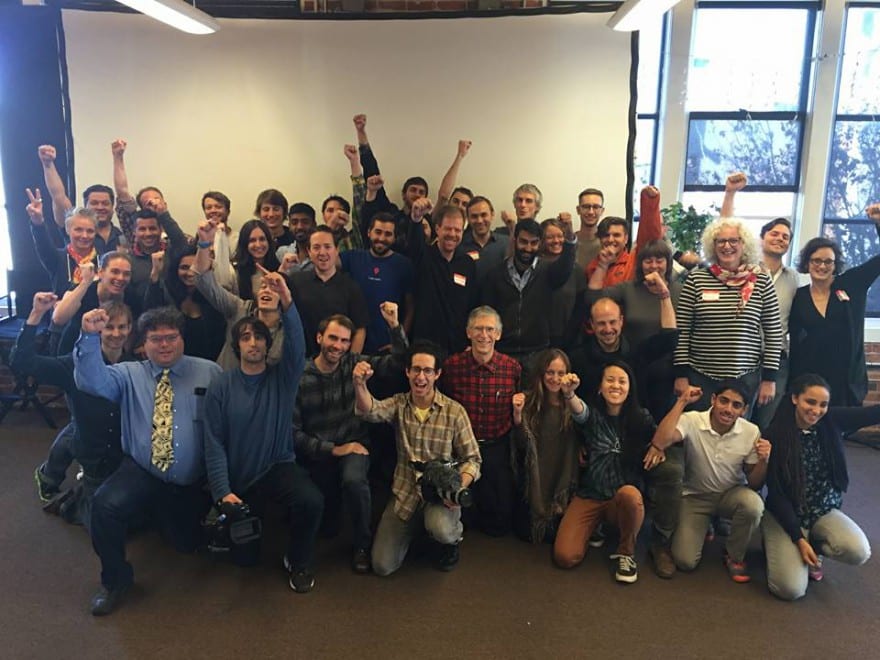
November 13-15, 2015, San Francisco. A group of basic income supporters joined forces for the first ever basic income ‘create-a-thon’. For those not familiar with the concept of create-a-thons, these are events where people from a range of professions meet up voluntarily to work and create something together. In general, they gather to work on a project that has a social dimension. Those events are inspired by the now famous hackathons that bring together software programmers, project managers and other creatives to work on developing new projects in just a few hours. The motto of the events: efficiency, creativity, and innovation.
So what does this have to do with basic income? The idea of the organizers was to use the great concept of create-a-thons to further the struggle for an unconditional basic income. They launched the event to harness the energy, creativity, skills and competences of an incredible mix of people over the course of a weekend. More than 100 people showed up at one point or another in the nice offices of the company Brigade in San Francisco, California. It really did look like a tech event: dozens of MacBooks and a lot of coffee. Developers, artists, filmmakers, community organizers, educators and seasoned basic income activists worked side by side. The participants chose a project, a sub-group, and then spent their weekend working on a particular idea.
So what did people actually do? A filmmaker made a movie where he asked each participant why we should support basic income. A group made a film called ‘Tell It To The Sun’ – a journey into the deepest reasons why people got interested in basic income in the first place; it made a few people cry. There was also a team that came up with a list of 100 reasons against basic income. Their idea was that better categorizing the objections is a first step in sketching a guide for campaigners. Helped by a group of activists that came all the way from Germany, another group launched the first American My Basic Income campaign in just three days! Everyone was amazed that all this content was created so quickly. You can see the full list of nine projects here.
Now the organizers are planning to help others create more basic income create-a-thons. They want people to benefit from this experience and are supporting those who want to meet up and get projects in place – click here if you want to find out more. Create-a-thons provide a great platform for basic income supporters to rally and coordinate, simply by inviting them to spend joyful and hopeful weekends working together. There is no doubt that many of the projects that started in San Francisco will have a long life.
And what better way to prove basic income skeptics wrong? The hard work and creativity unleashed at the first basic income create-a-thon show that people work and contribute to society in meaningful ways even when they don’t get paid for it. If people are willing to spend their precious weekends working together for a better future for all, then imagine what they could do for their communities with the extra time and security an unconditional basic income would afford them.
by Will Wachtmeister | Nov 21, 2015 | Opinion
A Swedish Green Party motion to investigate basic income policy options has injected new life into the UBI debate in Sweden. Several established commentators are finally engaging with the issue after a long period of ignoring or instantly dismissing the idea.
The Greens called for an inquiry into the effects of introducing a basic income at their party conference over the summer which predictably – given the political climate in Sweden – attracted much knee-jerk ridicule.

Swedish public intellectual Roland Paulsen
However, recently several heavy-hitting publications have run opinion pieces on the issue even if most are negative.
The debate has clearly been spurred on by additional factors such as moves towards basic income in neighboring Finland. There has also been tireless campaign work carried out by Swedish grassroots civil society groups and media advocacy by a number of public intellectuals, notably Roland Paulsen.
Well-established evening newspaper Expressen, a popular centre-right publication, this month ran an in-depth pro-UBI essay by Malin Ekman arguing that “a basic income for all” is far more realistic than “jobs for all” in tomorrow’s digital economy. The paper’s main national politics commentator has in the past dismissed the Greens’ basic income proposal as “immature” without further comment.
The moderate-conservative broadsheet Svenska Dagbladet earlier ran an in-depth essay by the center-right Center Party’s chief economist who called the implications of the basic income proposal “devastating for the economy and the environment” and said it reflected the Greens’ supposed “muzzy and unworldly” approach to politics.
The left-leaning cultural magazine Arena has also attacked basic income with an opinion piece by a macroeconomist saying UBI supporters were keeping silent about Sweden’s major refugee crisis because they knew their policy would only make the situation more difficult.
The nascent debate is taking place in a context where the prime minister’s Social Democratic Party remains wedded to its traditional active labor market approach, and a mix of demand-led and supply-side economic policies, to combat unemployment. The center-left government, which includes the Green Party, has set a goal of reducing unemployment to five percent by 2020, a target that has been widely condemned as unrealistic.
Further reading in SWEDISH:
Malin Ekman, “Medborgarlön allt mer realistiskt instrument” [Citizen’s income getting increasingly realistic as a policy] Expressen, 2 November 2015
Karl-Gösta Bergström, “Miljöpartiets fem omogna beslut” [Five immature decisions by the Green Party], Expressen, 14 June 2015
Roland Paulsen, “Att straffa de arbetslösa är en grymhet av historiska mått” [Punishing the unemployed is an injustice of historical proportions] Dagens Nyheter, 15 July 2015
Martin Ådahl, “Medborgarlön är dåligt för miljön” [Citizen’s income is bad for the environment] Svenska Dagbladet, 7 October 2015
Anders Bergh, “Därför tror ingen på basinkomst” [Here’s why no-one believes in basic income] Dagens Arena, 2 November 2015

by Citizens' Income Trust | Nov 19, 2015 | Opinion
Paul Spicker, Social Policy: Theory and Practice, Policy Press, 2014, xii + 499 pp.
This third edition of Paul Spicker’s Social Policy combines updated material from two previous books: Social Policy: Themes and approaches, and Policy Analysis for Practice. The subtitle of the new edition of Social Policy, Theory and practice, is accurate. As Spicker puts it: ‘Social policy has always been study for a purpose’ (p.3).
The book is organized in four parts: a study of society (welfare, inequalities, social problems and responses to them, needs, and indicators), policy (how policy-making works, models of welfare, principles and values, strategies, policy analysis), the organization and delivery of welfare (welfare sectors, public services and bureaucracies, service delivery, recipients, administration), and methods and approaches (research, evidence, application). The book is comprehensive and is an excellent resource for lecturers, students, and researchers. The guide to sources, the glossary, and the indexes, add to the book’s usefulness (although the index might have employed additional subentries).
The volume is not a detailed discussion of particular social policy fields. For that, the reader will need to refer to more specialized volumes. What this book does offer is a general education in how to study social policy in order to provide a context for detailed study of particular fields – and sometimes the text boxes provide illustrations of that process. So, for instance, a section on ‘universality’ is followed by a description of Liberia’s health care system.
One very good reason for not arranging the book into different social policy fields is, as Spicker makes clear in relation to poverty (p.222), that the different fields are all connected. For instance: any relevant strategy to improve a population’s health will need to provide for adequate income, good healthcare, high quality housing, and reliable sanitation.
The book raises some interesting questions for those of us interested in the reform of the benefits system – for instance: Should payment of a universal benefit be paid automatically, or is it important to enable people to exercise choice, and therefore to require them to make a claim for the benefit? (p.333). The book also provides some important arguments for universal benefits:
The argument for universality is the argument against selective approaches: the process of selection is inefficient, inequitable, difficult to administer, and it fails to reach people. By contrast, universal social provision can reach everyone, on the same terms. The degree of uniformity simplifies administration … . But there are also positive reasons for universality. One is the view that everyone has basic needs, and those needs can often be supplied more simply and effectively through general provision to everyone. … Second, universality has been seen as a way of establishing a different kind of society – one in which every citizen has a right to basic services, and the basic texture and pattern of social life is one in which people do not suffer unjustifiable disadvantages. (pp.218-9)
Social Policy: Theory and practice comes highly recommended as a thorough and stimulating introduction to the field.