by Karl Widerquist | Jul 22, 2019 | Opinion, The Indepentarian
The following is an extended excerpt from, “The Future of Work: Universal Basic Income and the Philosophy of Freedom,” by Romany Williams, SSENSE
.
The rhetoric that increased entrepreneurship equals a utopian society is one-sided. What about equality as a means for liberation from these systemic ideals?
“UBI is voluntary participation capitalism. What we have now is mandatory participation capitalism. I believe this model of mandatory participation capitalism is an affront to a free society,” says Karl Widerquist, Associate Professor of political philosophy at SFS-Qatar at Georgetown University and author of Independence, Propertylessness, and Basic Income: A Theory of Freedom as the Power to Say No. “Capitalism is based on people who own all the resources, and other people who can only use those resources if they take a subordinate position. Most of us will have no choice but to participate in the capitalist system, not as a capitalist, but as a worker for years. Basic income gives you the power to say no to that. To say, ‘I work because I want to, not because you threaten me with homelessness and starvation.’”
“The potential for robotics to give us more leisure is incredible if we’re allowed to take it. But most of us can’t demand that. If we don’t work 40 hours a week, 50 weeks a year, we don’t have any income,” says Widerquist. “We should all receive some of the benefits of automation. If you’ve had a job anytime in the last 40 years, you’ve done something to further the great economic growth we’ve had.”
Chronic economic insecurity is toxic and a sense of freedom doesn’t come from an Instagram feed filled with pictures of nature. Nor does it come from endlessly climbing the corporate ladder. The scarcity mindset that is perpetuated by the lack of proper compensation and workers’ rights only worsens mental health issues, making for an increasingly volatile social and political climate. History proves that the only way to change things is to mobilize. “Remember the 1% is only 1% of the people,” says Widerquist. “We have the other 99%.”
The author of the article excerpted here is Romany Williams, a stylist and associate editor at the fashion magazine, SSENSE, (pronounced “S-sense” or “essence”). I never expected to be interviewed for a fashion magazine, but he did an amazing job giving my ideas context and letting me speak for myself—for good or bad. I’d edit it slightly if I could.
The full text of the article is online: “The Future of Work: Universal Basic Income and the Philosophy of Freedom,” by Romany Williams, SSENSE


by Karl Widerquist | Jul 12, 2019 | Opinion, The Indepentarian
New Yorkers are organizing a march for Basic Income. Everyone who can get there is invited to join.
The
Basic Income March, led by
Basic Income NYC, is set for October 26, 2019. It might be accompanied by Basic Income Marches in other cities on the same day. The march can receive donations that are 100% tax deductible through its sponsor, the
Keith Institute.
This march is one more sign of the rapid growth of the Basic Income movement. It’s especially existing to those of use who where following the movement (such as it was) the 1990s when the presence of a half dozen Basic Income supporters in the same room felt like a novelty. Every year for the past ten years or so the growth of the Basic Income movement has surprised me, and only looking back did I realize that it had been growing in less obvious ways since the mid-80s.
Unfortunately for me, I can’t march. I’ll be out of the country when it happen, but I hope all my fellow Basic Income supporters in New York and maybe the whole USA can participate.
If you’d like to volunteer to help with the event,
Basic Income NYC is having weekly planning meetings–in addition to their regular monthly Basic Income meet-ups. Contact them about getting involved in the planning either of the New York event or of the possible marches in other cities. More information about the Basic Income March is available at
www.basicincomemarch.com.
–Karl Widerquist, Angers, France, July 12, 2019
NOTE: This report has been updated. The original date of September 19 was changed to October 26.

by Karl Widerquist | Jun 15, 2019 | Opinion, The Indepentarian
I’m posting chapters of my latest book project (The Prehistory of Private Property coauthored by Grant. S. McCall)
This discussion paper is a draft of Chapter 2 of our forthcoming book, the Prehistory of Private Property. It traces the history of the appropriation story in property theory from John Locke to the present day. It shows that, although the story is not supposed to be literally true, it is meant illustrate important empirical claims in the natural rights justification of private property. The natural-rights-based argument for ethical limits on government powers to tax, regulate, and redistribute property has to stand on the empirical claim that collective appropriation of property, though possible, is historically implausible—a claim or a collection of claims we call “the appropriation hypothesis.”
This hypothesis could be specified in at least three different ways. First, before governments or any other collective institutions appear, all or most resources are appropriated by individuals acting as individuals to established private property rights. Second, only individuals acting as individuals perform appropriative acts (i.e. neither individuals acting as monarchs nor groups intending to establish collective, public, or government-held property rights perform appropriative acts). Third, even if collectives perform appropriative acts, subsequent transfers of titles (in the absence of rights violations) are likely only to produce privatized property rights.
This chapter sets up the following questions, which will be addressed in the chapters 3, 4, & 5: Can the natural-rights justification of private property do without the appropriation hypothesis? And if not, are these claims true?

by Karl Widerquist | Jun 9, 2019 | Opinion, The Indepentarian
My latest book project (coauthored by the anthropologist, Grant S. McCall) is called The Prehistory of Private Property
. It book tells two parallel histories. It tells the story of how modern property theory became dependent on three misconceptions about the origin of the property rights system and the difference between societies with common and privatized resources, and how those misconceptions continue to have a negative effect on contemporary political thought and beliefs about our shared responsibility. The second story traces the origin and development of the private property system through history and prehistory to debunk those misconceptions.
The three claims at the center of this book are: 1. The normative principles of appropriation and voluntary transfer applied in the world we live in can only support a capitalist system with strong private property rights. 2. Capitalism is more consistent with negative freedom than any other conceivable economic system. 3. Inequality is natural and inevitable, or egalitarianism is unsustainable without a significant loss in freedom.
The book devotes a great deal of space to show how these misconceptions are embedded in many influential theories in political philosophy, because political philosophers are often unclear about the extent to which their theories rely on empirical claims. The clarity problem is nearly as important as the dubious nature of the claims. Obscurity and ambiguity help shield these claims from scrutiny.
Underlying this specific theoretical agenda is the more general goal of raising the level of discussion of empirical issues in political philosophy. Ambiguous allusions to empirical claims should be unacceptable in any academic literature. Philosophers have the responsibility to be clear about what empirical claims they rely on and about the level of support they can offer for those claims. Their critics should not let them get away with the sloppy use of ambiguous allusions to empirical claims.
Once the need for each claim is clearly established, the book subjects each claim to rigorous empirical investigation using the best evidence available from anthropology, and then discusses the implications of those findings for contemporary theory. Some of the book’s central findings follow.
- The normative principles of appropriation and transfer much more easily support common or collective claims to property. Private property rights systems tend not to develop without state aggression against small-scale societies with better claims of a connection to “original appropriation” than people establishing individualist private property rights.
- The hunter-gatherer band economy is more consistent with negative freedom than any other form of socio-political organization known to anthropology. If freedom is an overriding value, everyone must become a nomadic hunter-gatherer. This finding implies both that the justification of any other system must rely at least partially on some other value such as opportunity and that aid to the disadvantaged is not necessarily freedom-reducing: it often counteracts freedom-reducing aspects of private property.
- Inequality is not natural nor inevitable nor in conflict with freedom. Contemporary egalitarian theory can benefit from the experience of small-scale societies that successfully maintain very high levels of political, social, and economic equality.
The book is not directly about Basic Income, but it will connect to the idea in the final chapter. We will argue that the mass of humanity lead lives of manufactured desperation. People are not naturally in a struggle to “find work” to ensure they have food, shelter, and clothing. They are artificially put in this situation by a stratified property rights system that is not necessary for human social organization and that most societies (from the earliest hunter-gatherers to more recent peasant farming systems) did not find it necessary to manufacture such desperation. Basic Income is one way to compensate people for the imposition of a stratified property system and to relieve them of desperation that has come with it.
We have full drafts of 8 of the books ten chapters, and we are positing them online at this link as they reach presentable form. We hope to have a full draft we can send to our publisher (Edinburgh University Press) within a few weeks or months.
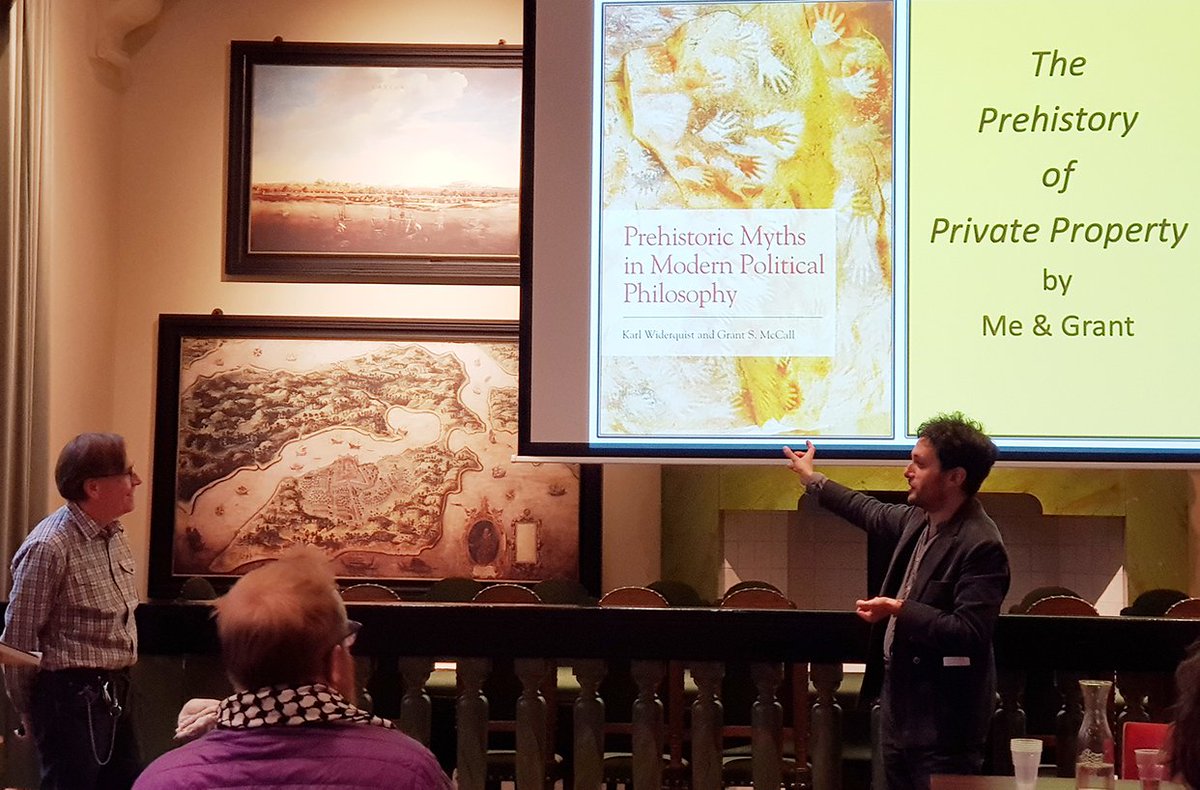
Enzo grills Karl at the PPA+ conference, Amsterdam, 2019

by Tyler Prochazka | Jun 4, 2019 | Opinion
The wave of basic income experiments in the last two years was a positive development in giving Universal Basic Income (UBI) some level of attention and political legitimacy in Western countries.
It is time to recognize the experimental wave is coming to an end.
Basic income activists in the next wave of UBI political discussions should push for policy changes in the direction of basic income. There are ongoing and completed trials testing cash transfers in countries with different stages of economic development. It makes more sense to build a foundation for policy changes as these results trickle out over the next few years rather than pushing for yet another experiment.
In Canada, the push for experiments backfired because a Conservative government canceled it before any results could be collected. I supported Ontario’s experiment and there was value in the research.
However, Ontario’s cancellation demonstrated that as activists move forward, we must recognize that experiments do not create a political constituency. In Alaska, the partial basic income policy has broad and significant support because everyone has benefited from it. Building a constituency that can be expanded and deepened is where activist energy should be placed in the next stage.
UNICEF funded experiments in India helped make basic income a real political discussion there, and now basic income inspired policies are being proposed by both of the main parties and a minimum income is set to be implemented in the state of Sikkim.
Experiments in developing countries and regions where basic income is still not well known may still be politically necessary. In Western countries, though, activist energy on more experiments rather than policy action seems ill-placed since UBI has already entered mainstream discussion in the West.
Experiments have already shown us cash transfers make people happier, healthier, and free them to pursue what they are interested in. The myths about basic income have been consistently undermined, particularly the idea that it would decrease work in any meaningful way. More experiments will keep telling us that giving people cash is generally good in most of the ways we measure positive outcomes.
How many times do we need an experiment to tell us cash transfers do not make people “lazy”?
Those who will not be convinced by the existing and upcoming experimental results will not be convinced by yet another experiment. The reaction to Finland’s experiment is evidence that unpersuadable opponents will latch onto even neutral effects on employment to prove basic income is a “failure.”
To truly put UBI to the test in America and Europe, actual policies that incorporate significant elements of basic income should be pushed. Cory Booker’s baby bonds is a start. Expanding the Earned Income Tax Credit that incorporates students and caregivers would instantly help millions. Political campaigns such as Andrew Yang’s are also important to bring the debate to a mainstream audience.
That is not to say pilot programs with the intent of expansion are not helpful. These provide valuable information to governments on how to implement basic income. Pilot programs with the primary intent of yet more research on “laziness” are the issue.
However, as the experimental wave of basic income begins to sunset, activists must look toward the next wave, which should focus on concrete policy steps that realize the spirit of basic income.
For these reasons, I see more experiments as an inefficient use of activist energy in the West. Worse, pushing experiments focused on gathering more data trades off with more useful discussions of how to bring elements of UBI to reality in the near-term.
by Karl Widerquist | May 17, 2019 | Opinion, The Indepentarian
At the links below, you can find 492 pages of notes, mostly in anthropology, some in history and other disciplines. I accumulated them in the process of researching two books (Prehistoric Myths in Modern Political Philosophy and the Prehistory of Private Property), both of which use(d) sources from anthropology and other disciplines to criticize empirical claims philosophers and political theorists often accept without sufficient skepticism. These notes are not a broad-based coverage of the discipline as a whole; they involve only information relevant to the claims addressed in those books. I’m posting them publicly (in both DOCX and PDF formats) in case anyone doing related work will benefit from them in any way. I hope some people find these notes to be a useful aid for their own research.
Four-hundred and ninety-two pages of anthropology notes (in DOCX format)
Four-hundred and ninety-two pages of anthropology notes (in PDF format)