by Jenna van Draanen | Mar 11, 2015 | Opinion

Scott Santens, “What I’ve observed since 2013 in the discussion about a basic income guarantee: How a BIG could be closer than we think” www.scottsantens.com.
February 26, 2015.
by Citizens' Income Trust | Feb 20, 2015 | Opinion

Bruce Nixon, A Better World is Possible: What needs to be done and how we can make it happen, O Books, 2011, 1-84694-514-4, pbk, 396 pp, £14.99
This really is a book about everything: the financial crisis, climate change, peak oil, ecosystem destruction, poverty, and war: and it is about solutions to everything, with the solutions organised in layers: first, principles, then the required paradigm shifts, and then the detail. For instance, in relation to climate change: the solution is ‘greening the world’; basic principles are, for instance, ‘minimise use of non-renewable resources …’; one of the paradigm shifts required is ‘from linear to cyclical production processes’; and that paradigm shift is then spelt out: ‘Creating an economy founded on solar and nature’s energy and the principle of recycling’. Perhaps the best way to describe the book is as an instruction manual for the planet.
In relation to the economy, Nixon calls for money to be created only by national reserve banks as agents of the state, and not by commercial banks; and he calls for a Citizen’s Income to be paid for by a Land Value Tax. Nixon’s two main reasons for calling for Citizen’s Income are that it would ‘reduce the need to chase economic growth for the purpose of income distribution’ and that it would ‘introduce the culture of sharing, recognising that everyone has a right to a minimum share in wealth created through the use of skills and technologies that are our common heritage’ (p.142).
Chapters follow on community democracy, food sovereignty, sustainable cities, an end to war, and (again) climate change. A final chapter is titled ‘What we need to do’, by which Nixon means both ‘What the whole of humanity needs to do’ (for instance, ‘fair taxation, land value tax and citizen’s income’ (p.205)) and ‘What you can do’ (for instance, ‘organise … massive education and awareness raising’ (p.206)).
This book is both exhaustive and exhausting, and properly so. Some massive interconnected problems face the human race, and to bring so many of them together in a single book makes clear the size of the task and the fact that change is required at every level: global, nation state, local community, and individual. The size of the task suggests that success might be out of reach, and that we should resign ourselves to runaway climate change, resources wars, and poverty; but that is not where the book ends up. Nixon is a fan of Mahatma Gandhi: ‘Whatever you do may seem insignificant, but it is most important that you do it’ (quoted on p.209).
As the book suggests, just one element of the diverse and complex changes required of us is a Citizen’s Income. This is one element of Nixon’s massive wish-list that is achievable in the medium term and that could be implemented without requiring additional public expenditure. It could be an early win in the long process of creating a ‘better world’. Until it happens our task remains ‘education and awareness raising’ (p.206), and it is most important that we do it.
by Citizens' Income Trust | Feb 13, 2015 | Opinion
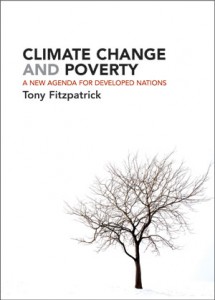 Tony Fitzpatrick, Climate Change and Poverty: A new agenda for developed nations, Policy Press, 2014, x + 259 pp, hbk, 1 44730 087 8, £70, pbk, 1 44730 086 1, £24.99
Tony Fitzpatrick’s claim in this book is that climate change turns the tackling of poverty into a new agenda, for developed countries as well as for developing ones, because in developed countries such as the UK climate change exacerbates poverty and poverty has an impact on climate change.
The author defines poverty as:
a form of injustice, denoting a relative lack of those resources needed to ensure a minimal standard of living, equal opportunities, mutual social respect and participative inclusion in a society’s way of life, and without which it is difficult to flourish, to fulfil one’s potential and to achieve or sustain a decent level of wellbeing. Poverty is characterised by socioeconomic conditions that empower those who monopolise key resources at the expense of those who do not, such that poor individuals are disrespected by, for instance, being held responsible for social circumstances they did not create and over which they have limited control. (pp.11-12)
Fitzpatrick therefore parts company with a ‘capabilities’ approach to poverty, which regards as context-specific the capabilities required by someone if they are to experience such basic ‘functionings’ as sufficient food, shelter and health. Fitzpatrick’s argument is that both social and natural environments require a ‘just distribution of material and economic resources’ (pp.25, 34). It is adequate resources that make capabilities possible.
Fitzpatrick again links the natural with the social when he defines ‘ecosocial poverty’ as
falling below some decent minimum access to, ownership of and control over key socionatural resources due to malfunctioning social institutions and systems. (p.53)
Socionatural resources, such as land, take up space, so
ecosocial poverty implies an ecospatial deprivation, that is, an alienation and exclusion from (1) the socionatural resources dispersed across space, and (2) space as a distinct resource that shapes the life course of individuals and the value and distributions of those socionatural resources. (p.73)
Similarly, ecosocial poverty is time poverty: time overcontrolled by others, or time of poor quality, characterised by enforced inactivity or by lousy jobs. Fragmented space and time are at the heart of the ecosocial poverty that Fitzpatrick is discussing.
The second part of the book tackles particular ecosocial policies: energy and fuel poverty (both transitions to renewable energy sources and the protection of poor people’s access to energy are essential); food and food poverty (health-promoting regulation of the food industry is required, not denigration of the poor for unhealthy eating habits); land, housing, urban density, transport, flooding, and waste (rent-seeking in the property market has created both urban sprawl and housing poverty, and land value tax could be part of the solution); air and water quality ( – complex issues: any expansion of water-metering will require that poor people should be protected; and both air pollution and climate change can and should be tackled together).
Fitzpatrick’s conclusion is that ecosocial poverty
is something that can only be addressed through new forms of economic organisation and growth which are socially inclusive and egalitarian, deriving from renewable, low carbon sources of energy and dedicated to the restoration of natural environments that have been destroyed or eroded in the modern era. (p.214)
While Fitzpatrick’s agenda in this book is the resources that take up space, our access to those resources is mediated through a financial system, the characteristics of which influence the different levels and types of access to those resources that different people enjoy or suffer.
Any readers who wish to pursue that related agenda might with profit refer to the same author’s Freedom and Security: An introduction to the Basic Income debate (Macmillan, 1999), where he recommends ‘a Green policy package’ that would ‘include not only [a Citizen’s Income] but also land and energy taxes, working-time reductions and the expansion of informal exchanges in the third sector’, with the Citizen’s Income seen not as one of a number of ingredients, but as ‘the instrument by which that package is constructed in the first place’ (Freedom and Security, p.201).
Readers might also appreciate a recent essay by Richard Wilkinson and Kate Pickett: A Convenient Truth: A better society for us and the planet
(Fabian Society, 2014) in which they connect environmental sustainability and greater economic equality. In their view the required sustained increases in equality could be generated by greater workplace democracy, but they also recommend both a Citizen’s Income and a land value tax.
Both social justice and environmental sustainability are essential. Both deserve more discussion, and they deserve to be discussed together. Both Fitzpatrick’s and Wilkinson’s and Pickett’s recent books will help us to do that.
by Citizens' Income Trust | Feb 6, 2015 | Opinion
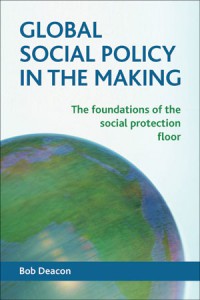 Bob Deacon, Global Social Policy in the Making: The foundations of the social protection floor, Policy Press, 2013, xii + 218 pp, 1 4473 1233 8, hbk, £70, 1 4473 1234 5, pbk, £24.99
In a world in which so many bad things happen, and in which so much media and academic reporting is of bad news, it is a real pleasure to read a good news story well told: for that is what this book is – a well-written report of a piece of very good news: that in 2012 the International Labour Organization (ILO) and the G20 agreed a proposal for global social protection floors (adapted to the circumstances of each country).
So the book is in effect a single extended case study: and as the story is told we discover the internal dynamics of the ILO and of other international organisations, the relationships between the international institutional actors, and the other influences that led to the recommendation.
Of particular interest is a handful of individuals whose personal interests were particularly significant as the social protection floor policy evolved. Some of these individuals were in leadership positions in the ILO, but some were simply in significant positions in the organisation at the right time to reinforce existing trends. So, for instance, Deacon charts how an appreciation of the benefits of universal social provision had re-emerged as a neoliberal means-tested safety-net stance began to reveal its disbenefits, and how an influence on this process was Guy Standing’s work as head of a relevant departmental subsection. But however significant individuals might have been, the logic of the changing context comes across as an even more significant factor. The ILO’s focus was, and still is, on ‘labour’, so social insurance schemes have understandably received more attention than other social security provision. The increasing precarity of the labour market (another focus of Guy Standing’s work) has revealed the inadequacy of social insurance as the only or main social security mechanism, and has also revealed the benefits that universal benefits and services might offer.
Much of the book is about which organisation did or said what, and if this kind of narrative does not interest you then by all means skim some of this material: but don’t miss the way in which individuals, context and alliances can generate significant change within organisations such as the ILO; and don’t miss the ways in which one changing organisation can, in the midst of a changing social and economic context, contribute to change in other organisations – including the World Bank, where a process of change was facilitated by a change of leadership at the same time as the context and the ILO were changing.
The case study is of course a particular one, but it offers more general lessons, and Deacon is right to suggest that the study provides evidence for an ‘ASIP’ understanding of social policy formation: ‘agency, structure, institutions and discourses’ (p.143). If all four factors are moving in the same direction then policy might well change.
Social policy both will and must become more global: it will, because organisations that relate closely to each other increasingly behave like each other; and it must, because labour market, economic and social change will continue to be influenced by globalisation and by global financial institutions. This book is an excellent preparation for further study of globalising social policy, not only of the specific principles represented by the social protection floor recommendation – ‘universality of protection, based on social solidarity; entitlement to benefits prescribed by national law; non-discrimination …’ etc. (p.98) – but also of the factors affecting a direction of travel.
The story related here suggests a trajectory in the direction of universal provision. It will be interesting to see whether the trajectory can be maintained; and also whether the lessons will be learnt in relation to social security benefits. Increasing labour market precarity means that social insurance schemes will be increasingly irrelevant; the disincentives and other disbenefits of means-tested systems will be increasingly obvious; and universal benefits will be increasingly relevant. If this discourse becomes more widespread, if sufficient numbers of people in significant positions understand it, and if institutions and structures find themselves moving in more universalist directions, then we could well see a Citizen’s Income either nationally or regionally sooner than we might think.

by Unconditional Basic Income Europe | Jan 31, 2015 | Opinion
The European Central Bank’s attempt to counter-attack deflationary pressure by giving banks funds raised through QE is doomed to be both ineffective and anti-redistributive. The ECB must consider more unconventional policies if it hopes to get the real economy going again.
Press release by our affiliate Unconditional Basic Income Europe (january 23, 2015)
 Update November 2015:
UBI-Europe is one of the 20 organisations that have joined the campaign “Quantitative Easing for People.” Citizens and organisations can join the campaign here: www.qe4people.eu
At the announcement of its quantitative easing program yesterday, the ECB showed that it has learned nothing from recent quantitative easing programs in the UK and the US, where the effects of QE on the real economy has produced no significant results.
“The experience of the US shows that QE is useful to the real economy only when they are combined with expansionary fiscal policies. In Europe, the idea is to combine QE with austerity policies, guaranteed to offset any potential benefits of QE. So, in the absence of a radical change in the eurozone’s fiscal stance, we expect the depression to continue.” said Thomas Fazis, member of UBI-Europe, referring to the conclusion of a recent paper he wrote.
Quantitative Easing is anti-redistributive
At its worst, such a program could increase inequalities. As the Bank of England itself concluded in a recent research paper (pdf): “By pushing up a range of asset prices, asset purchases have boosted the value of households’ financial wealth held outside pension funds, but holdings are heavily skewed with the top 5% of households holding 40% of these assets.”
In short: this QE benefits the rich, not the poor.
There is an alternative: Quantitative Easing for the People
Unconditional Basic Income Europe calls the ECB for an alternative monetary policy such as distributing QE money directly to the pockets of citizens.
“QE for the people is not just a more efficient approach for directly stimulating the real economy, it is also more fair in the current context of deep social inequalities and the rise of extreme poverty in the eurozone. By doing so, the ECB could target two objectives at once.” Thomas Fazi said.
This might sound radical, yet many economists such as Anatole Kaletsky and Steve Keen have backed the idea.
Several proposals for such a policy have emerged recently, notably from Oxford economist John Muellbauer and the chief European economist for the French investment bank Natixis, Sylvain Broyer. Muellbauer calls distributing 500€ to every citizen in the Eurozone, while Broyer’s proposal amounts to 3,000€.
The amount of QE money unveiled yesterday by the ECB could, alternatively, fund a €2100 annual cheque to all residents of the eurozone.
“Such a policy could be a pragmatic, direct pathway towards an unconditional basic income for all in the eurozone. It would set a precedent.” UBI-Europe’s coordinator Stanislas Jourdan said. “Where citizens can be counted on to spend, banks have not shown with previous QE programmes that they can be counted on to lend.”
Quantitative Easing for the People would not violate EU Treaties
“As opposed to having the ECB financing governments and public entities, handing cash directly to the citizens is not explicitly prohibited by the EU Treaties.” Thomas Fazi explained.
Moreover, such a program would be far more protective of the independence of the ECB. By targeting the quantitative easing money to all citizens without distinction, the institution could not be blamed for interfering with governments.

by Liam Upton | Jan 18, 2015 | Opinion
This is an interview with Nick Barlow, founder of the ‘Liberal Democrats for Basic Income’ group, you can read an article about the group here.
BINews: What stage is the Basic Income Liberal Democrat group at now and where do you see it going in the next 5 or so years?
Nick Barlow:
We’re still very much at the coming together stage (top tip: don’t try organising a new group just before the Christmas break) and about getting the idea out there and discussed.(see this article for instance). There’s no formal structure to the group yet beyond an email list and a Facebook group, but people are joining up.
Realistically, I think the key time for basic income supporters in the party is going to be after the general election, when I think people will be looking at how we move forward and develop the party in the coming years. I would hope that in some point within the next couple of years we’d be able to take a proposal to party conference to be debated.
BINews: What makes you think the Liberal Democrats are particularly suited to adopt the policy of Basic Income?
Nick: First, because it was party policy before between 1990 and 94, and it was also suggested and discussed (usually alongside Land Value Tax) in the old Liberal Party.
I think there’s a need for a liberalism in the twenty-first century that understands a lot more has to be done to ensure positive liberty. For me, a basic income is a way of ensuring that basic level of provision for everyone which enables them to be free and to give them power. If we are serious about freeing people from poverty, ignorance and conformity – the party’s purpose, according to its constitution – then a basic income is one of the best ways of doing that.
BINews: What steps do you think are necessary for the idea to gain traction within the party and eventually be adopted?
Nick: First, I think we need to build awareness and challenge some of the preconceptions against basic income. A lot of people (in the party and society as a whole) just aren’t aware of the idea, so there’s work to be done in making people realise it is possible. In a wider sense, I think there needs to be a wider discussion about the future of the party and how people see liberalism. Basic income is just one idea that the party could adopt if it wants to be different, but we first have to answer the question of whether we strike out and be different, or just go for a centrist position.
BINews: Do you envisage it being adopted by the party within the next 10-15 years?
Nick: I think it’s entirely possible it could be adopted by the party within five years, if the party is willing to try a new direction.
BINews:
What impact do you think the adoption of Basic Income would have on support for the party?
Nick: It’s very hard to say, because there’d obviously be a lot of negative publicity from the mainstream press, especially given the current coverage of anything to do with benefits, but it would open up a lot of potential new support (and reclaimed old support) who are people interested in doing things differently, As a key idea to show how we’re different from the big two parties, it would stand out, but the party would have to be willing to take the flak that comes with it in order to stand out.
If you look back at the party’s manifesto in 1992, basic income (Citizen’s Income as it was branded then) wasn’t just one policy, it was part of a wide-ranging set of policies that would have reshaped the whole relationship between the individual and the state. It was that commitment to doing things differently that I think helped rally the party from the low points of the late 80s and helped it recover.
BINews: Do you see the idea of Basic Income becoming a mainstream idea in British politics in the near future?
Nick: I think it’s unlikely in the short term, just because of the sheer level of demonisation the very concept of benefits is receiving at the moment. I think to get more widespread acceptance of basic income needs not just that to change, but for people to be more aware of how the way the economy works has changed. I’ve written before about the concept of ‘workism’, and how we fetishise the idea of people having to work, and that’s deeply rooted in our culture.
Basic income isn’t just a small adjustment to the system, it’s about a much more fundamental change than other policies, and to make it mainstream means a whole lot of wider attitudes need to change. To get back to the point, one of the reasons for looking to start a Liberal Democrats for Basic Income group was to help promote the debates and discussions we need to have, and keep having, to get the idea more widespread attention. Shifting widely-held attitudes takes a long time and a lot of conversations.