by Matu Mureithi | Nov 9, 2026 | News
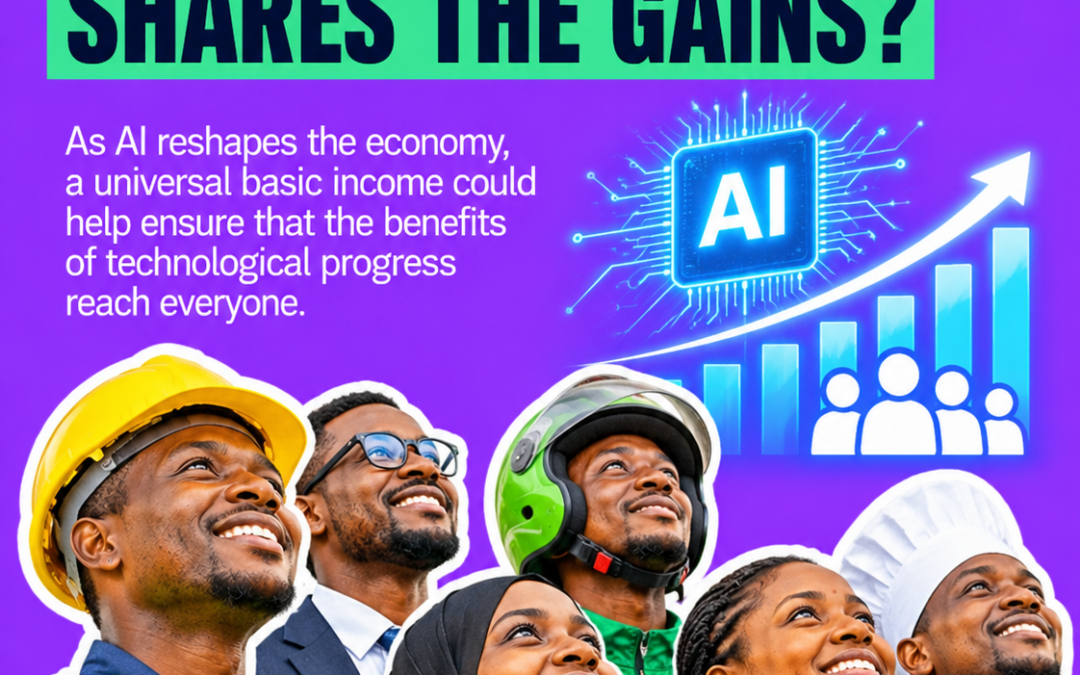
AI has put basic income back on the policy agenda. But the more useful question isn’t whether we need a response. It’s what Artificial intelligence is accelerating changes in the labour market and bringing renewed attention to Universal Basic Income (UBI). In an article published in The Meridian in November 2026, the author argues that the growing scale and speed of AI-driven job displacement are challenging traditional assumptions about employment, income security and the role of social protection.
The article highlights figures from Challenger, Gray & Christmas, which reportedly recorded 87,000 US job cuts attributed directly to AI between January and May 2026. Unlike previous waves of automation, which unfolded over decades, AI is transforming entire categories of work at a much faster pace. This raises questions about whether existing welfare systems, largely designed around the assumption of continued employment, can adequately protect workers.
The article also revisits common objections to UBI, particularly concerns about work incentives and affordability. Evidence from initiatives such as the Stockton Economic Empowerment Demonstration and Alaska’s Permanent Fund Dividend challenges the assumption that unconditional payments discourage employment. Meanwhile, the significant fiscal costs of implementing a meaningful universal income remain a major political obstacle.
One emerging proposal is an automation dividend: taxing a portion of the productivity gains generated by AI and redistributing the proceeds to help establish an income floor for workers affected by technological displacement.
Importantly, the article draws attention to the Global South, where the consequences of AI-driven job losses could be particularly severe. Countries such as Kenya, India, Nigeria and the Philippines have significant workforces in business process outsourcing, customer service and data-related industries that are increasingly exposed to automation. Unlike many developed economies, these countries often lack comprehensive social protection systems to cushion displaced workers.
The central argument is that the debate is no longer simply about whether AI will disrupt employment, but about how societies will distribute the economic gains from technological progress. As AI increases productivity while potentially reducing demand for human labour, UBI and other forms of guaranteed income deserve serious consideration as part of the response.
Read the article: https://www.themeridian.info/november-2026/3440057_universal-basic-income-is-coming-ai-forced-the-conversation

by Matu Mureithi | Nov 9, 2026 | News
One person bought a knitting machine to help start a small business. Another enrolled her daughters in a dance class. A third is saving up to buy a home.
Last October, 53 Brookline residents received a check for $750, the first of 12 from a pilot guaranteed income program.
A year later, on Thursday, the participants marked the end of the program at “Together We Rise,” an event put on by the organizations that led the pilot.
The Brookline Community Foundation and Brookline Housing Authority, along with the national nonprofit UpTogether, joined together to run UpTogether Brookline. It was funded by the American Rescue Plan Act, a COVID-19 era federal recovery package, and an additional grant from BCF.
The guaranteed monthly payments were embedded into a “Self Sufficiency Program” run by BHA, Brookline’s public housing agency, that offers multiple years of coaching and asset building expertise. The participants, who are residents in Section 8 and public housing, used the funds to boost themselves into new financial situations.
“It has really opened a lot of doors for residents to begin to think beyond paycheck to paycheck, into ‘What would they envision for their future?’ We’ve seen so much growth,” said Danielle Mendola, the BHA residence service director.
UpTogether’s survey of the Brookline cohort recorded significant shifts in participants’ ability to pay for household expenses and reduce debt. All of the residents who were behind on rent payments at the beginning of the program have caught up on those expenses. Read more https://zurl.co/SlAWa
by Matu Mureithi | Oct 30, 2026 | News
2 November 2026 | 6:30 PM IST / 1:00 PM GMT / 7:00 PM BDT | Online
Event details
- Date: Monday, 2 November 2026
- Time: 6:30 PM IST | 7:00 PM BDT | 1:00 PM GMT
- Format: Online webinar
- Registration: Free, through Eventbrite
Register for the webinar:
https://www.eventbrite.co.uk/e/tdh-handbook-of-relational-needs-based-organising-launch-webinar-tickets-1997330834292
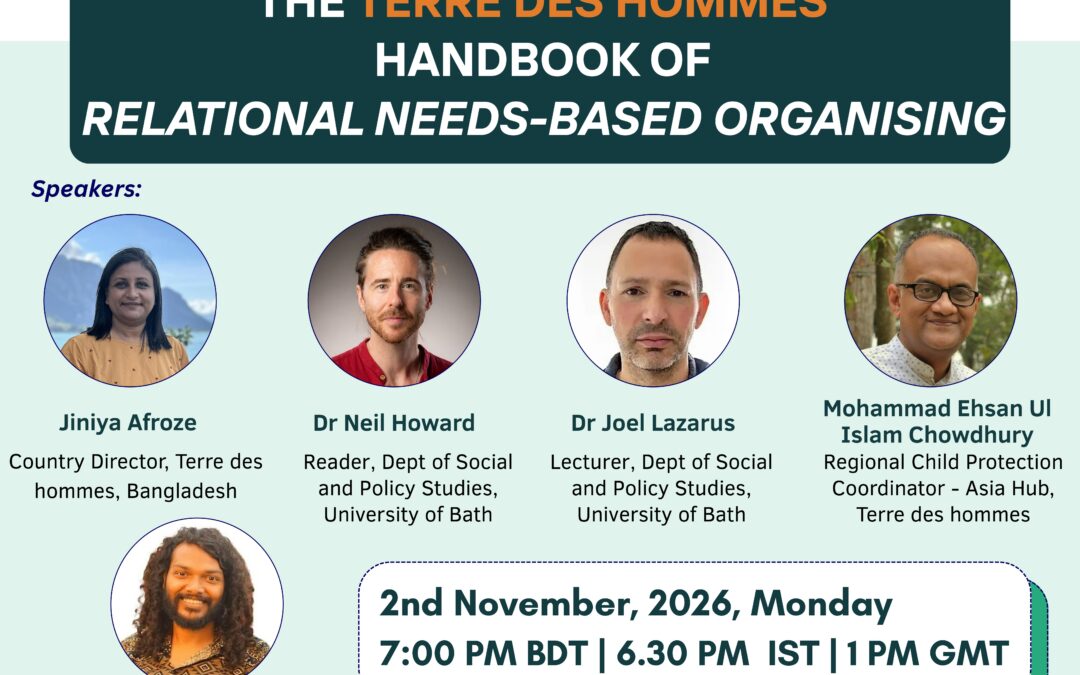
The Terre des hommes (Tdh) Handbook of Relational Needs-Based Organising (RNBO) will be launched through an international webinar on Monday, 2 November 2026, at 6:30 PM IST (1:00 PM GMT / 7:00 PM BDT). The webinar will bring together researchers and practitioners to discuss an alternative approach to social work, community organising and development practice, drawing on learnings from two major Universal Basic Income (UBI) pilot projects in South Asia.
The Handbook builds on the experiences and learnings of CLARISSA Social Protection Plus (SP+) in Dhaka, Bangladesh, and WorkFREE in Hyderabad, India. Implemented between 2020 and 2024, these multi-year UBI pilot projects combined unconditional cash transfers with relational, needs-centred social work and community organising. This integrated approach, described as UBI Plus, placed relationships, human needs and community-led processes at the centre of social interventions.
The Handbook brings together the theoretical foundations, practical frameworks and facilitation tools developed through these experiences. It introduces Relational Needs-Based Organising as an alternative to conventional, problem-solving approaches to development and social work. Rather than positioning development practitioners as problem-solvers or saviours, RNBO emphasises building relationships, understanding people’s needs, strengthening collective consciousness and supporting individuals and communities to identify and pursue their own pathways to change.
Structured around a five-stage process – Relating, Reconnecting, Raising Consciousness, Reimagining and Responding, the Handbook offers practical guidance, participatory methods and reflections from community participants and practitioners involved in the two pilot projects. It is intended as a resource for social workers, community organisers, development practitioners, researchers and anyone interested in more democratic, relational and empowering approaches to social transformation.
Speakers
The webinar will feature contributions from:
- Jiniya Afroze – Country Director, Terre des hommes, Bangladesh
- Dr Neil Howard – Reader, Department of Social and Policy Studies, University of Bath
- Dr Joel Lazarus – Lecturer, Department of Social and Policy Studies, University of Bath
- Mohammad Ehsan Ul Islam Chowdhury – Regional Child Protection Coordinator, Asia Hub, Terre des hommes
- John Michael – Member, Regions Team, Basic Income Earth Network (BIEN)
Access the Handbook: https://tdh-bangladesh.org/wp-content/uploads/2026/08/RNBO-Handbook_23-Aug-2026.pdf

by Matu Mureithi | Oct 28, 2026 | News
The Opportunity Party is campaigning for a major tax reset built around a Citizen’s Income, a regular payment of up to NZ$370 per week for almost all adults.
The proposal combines three reforms:
-Citizen’s Income: financial security for everyone, replacing most existing benefits while retaining additional support for those who need it.
-Land Value Tax: shifting the tax burden towards land to help make housing more affordable.
-KiwiSaver 2.0: strengthening retirement savings through compulsory contributions.
Opportunity argues that this package could ease cost-of-living pressures, reduce poverty and make work pay by removing benefit-related penalties on additional earnings.
It’s an ambitious proposal that puts universal income at the centre of a broader debate about fairness, housing and economic security. It remains a party proposal, not an implemented policy.
Read the proposal here: https://www.opportunity.org.nz/tax-reset
#BasicIncome #NewZealand #CitizenIncome #UBINews #BIEN

by Matu Mureithi | Oct 22, 2026 | News
From August 20 to 22, researchers, advocates, policymakers, and people with lived experience from 25 countries gathered at Toronto Metropolitan University for the 25th Basic Income Earth Network Congress, hosted by the Basic Income Canada Network. This event also marked the 40th Anniversary of the Basic Income Earth Network.
This year’s theme, “Basic Income and the Polycrisis: The Key to Unlocking the Puzzle,” asked a big question: can basic income serve as a unifying response that cuts across policy silos? Over 120 presentations from around the world responded to this question, highlighting how basic income can provide a vital foundation for equity and the elimination of poverty, environmental regeneration, food security, housing reform, reconciliation with marginalized communities, and political stability. The breadth, depth, and quality of work across BIEN’s global network made the 2026 Congress a location for dialogue and engagement on the most pressing issues of our time.
Across the three days, a few moments stood out.
The inclusion of major film projects, documenting the experiences and impacts of basic income provided opportunity for storytelling and community dialogue. This was punctuated by the global launch of The Elephant Run, a film documenting the story of the global basic income movement, and of Bootstraps, a docuseries that followed the lives of participants in a basic income experiment. Both film events were well received, and provided an emotional and celebratory highlight of the Congress.
Two global plenaries that framed the Congress theme provided participants with deep insights into the nature of the crises we face collectively and of the ways in which basic income can provide the foundation of national, regional, and global responses to these crises. These sessions also spoke to the common challenges and opportunities that our movement faces as we push for social and economic equity and justice around the world.
Finally, the pre-Congress Canada Day session provided a rare opportunity for Canadian advocates to gather with international colleagues to understand where the movement is at the moment in Canada. This event allowed for deep reflection, honest dialogue, and movement building that will be the foundation of work toward a basic income in Canada for many years to come.
What can we take away from our time in Toronto? First, we have affirmed what we likely already know, that basic income works best not as a standalone fix to the complex challenges that we face, but as a foundation that enables deeper structural change when paired with community-governed infrastructure, social programs, and public services. But more importantly, this Congress has allowed us to assess and understand our collective struggle. Globally, the polycrisis is deepening inequality and poverty, degrading our environments, decreasing security, and driving conflict. Gathering at this Congress, we have further laid foundations for solidarity, learning, and action toward a better global future.
Our thanks to Toronto Metropolitan University, the BICN team, our colleagues at the University of Pennsylvania, who provided the spark for the 2026 Congress, the volunteers who made the Congress run smoothly, and to all of the participants and presenters who made the Congress a rewarding, interesting, and valuable experience.
We now look forward to 2027 and joining our colleagues in Poland.
In solidarity and with thanks,
Ben Earle, General Manager, Basic Income Canada Network