
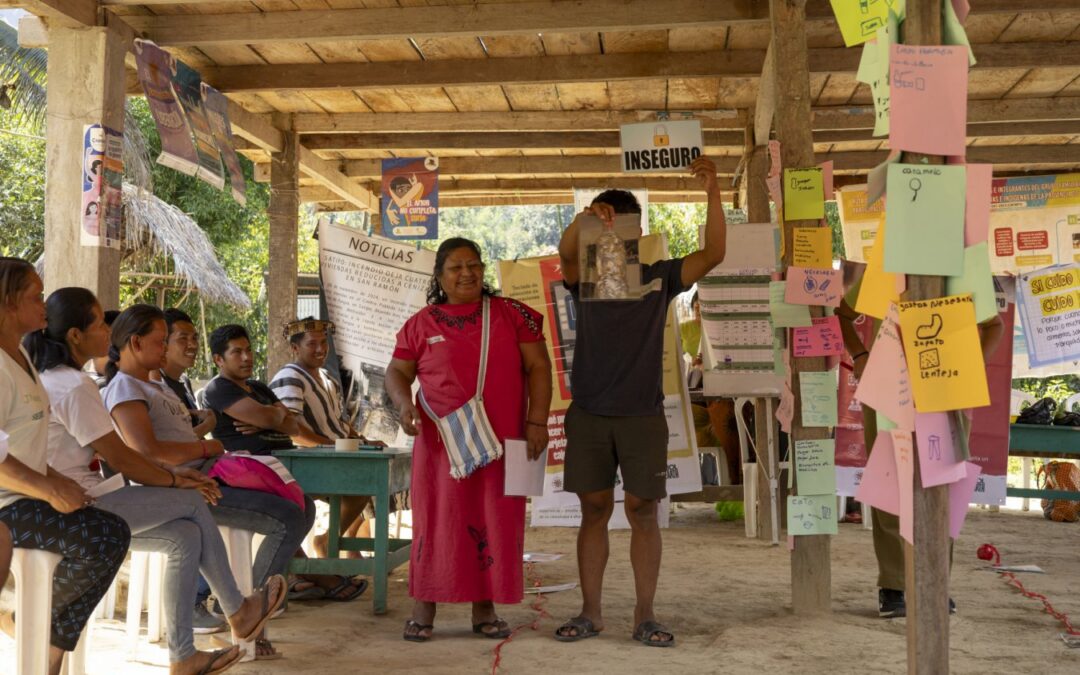
A new trial in the Peruvian Amazon is about to put this question to a more rigorous test, and its findings could have important implications for both basic income and community-led conservation.
The initiative, led by UK-based charity Cool Earth, will see almost 400 Indigenous people receive regular cash payments equivalent to approximately £57 per person per month. The trial is expected to run for at least two years, with the possibility of extending to four.
The thinking behind it is that when Indigenous communities have greater financial security, they may be less likely to depend on activities that put pressure on their forests, such as leasing land to loggers, miners or agricultural businesses.
Rather than prescribing how people should spend their money, the approach gives communities the freedom to decide what matters most to them.
As Caterina Cosmopolis of Cool Earth puts it, the aim is to build autonomy within communities, enabling people to make their own decisions and find their own solutions.
This new trial builds on a two-year pilot launched in 2023, which provided unconditional cash transfers to 211 people across three communities in Peru’s Junín province. Participants also received community-led training in financial education, climate change, environmental conservation and Indigenous rights.
The results, published by the University of Bath in October, were encouraging. The pilot reported improvements in food security and community wellbeing, while 90% of participants adopted environmentally beneficial activities, including reforestation and reducing forest burning.
However, there was an important limitation: the pilot did not have sufficiently rigorous environmental monitoring or control groups to establish whether the payments actually reduced deforestation.
The next phase is designed to address that gap. It will include two control communities that will not receive payments, alongside more systematic monitoring of environmental outcomes.
But there is another important question here: what kind of conservation model are we trying to build?
Some conservation programmes provide financial incentives only when communities meet specific environmental targets. This is commonly known as Payment for Ecosystem Services (PES).
Conservation basic income takes a different starting point. It recognises that Indigenous communities have their own priorities, knowledge and governance systems. They should not have to demonstrate environmental performance to justify receiving an income that strengthens their ability to make decisions about their lives.
This distinction matters. As researchers quoted in the article caution, linking payments to specific environmental outcomes risks turning an unconditional income programme into another conditional conservation scheme.
There are also legitimate concerns about sustainability. Temporary cash interventions can create uncertainty if communities come to depend on payments that eventually disappear. And environmental benefits should never be assumed simply because cash has been distributed. They must be independently measured.
These are important challenges, not reasons to dismiss the approach.
Too often, Indigenous communities are expected to protect ecosystems while facing economic insecurity and pressure from commercial interests seeking access to their land and resources.
What if conservation began by strengthening the economic security, autonomy and decision-making power of those communities?
The Amazon trial may not answer every question. But by combining unconditional payments, community-led learning and stronger environmental evaluation, it could provide valuable evidence about whether income security can contribute to lasting conservation outcomes.
Read the full article here : https://www.newscientist.com/article/2600784-new-basic-income-trial-in-peru-aims-to-prove-rainforest-protection-merits/
