by Karl Widerquist | Jul 28, 2013 | News
The situation of the Basic Income movement is evolving rapidly. This slide show, presented at a conference in Berlin, summarizes some of the developments of the Basic Income movement in France in 2013.
Jourdan, Stanislas “The Basic Income Movement in France,” Slideshare.net 30 May 2013
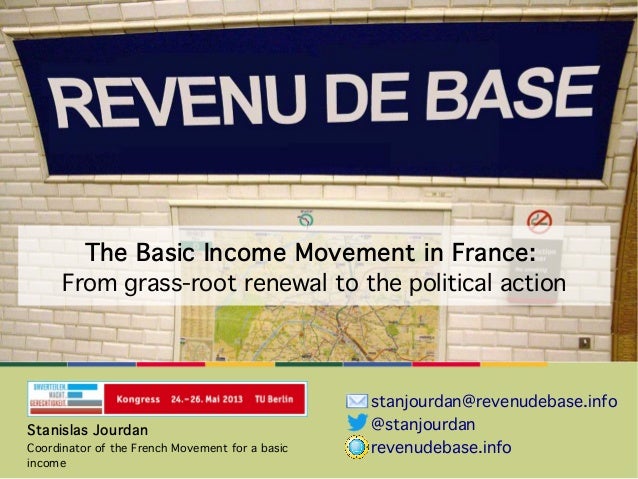
The Basic Income movement in France 2013
by Karl Widerquist | Jul 19, 2013 | Research
The left-wing French journal Mouvements devoted its entire Spring 2013 issue to basic income. This substantial volume includes no less than 20 papers on the various aspects of basic income. While most authors are very much in favour of it, some are more skeptical. Sociologist Bernard Friot, for instance, argues in favour of a complex “universal wage” system, in which the guaranteed income would not be disconnected from one’s qualifications. The issue also includes a micro-simulation for the implementation of a basic income in France, by economist and basic income activist Marc de Basquiat. Furthermore, the editors have interviewed two prominent academic figures, sociologist Robert Castel and philosopher Philippe Van Parijs. Castel insists on the fact that paid work, i.e. the labour market, remains of paramount importance for social recognition and self-esteem, and he does not endorse basic income. Van Parijs, by contrast, explains why he supports it, and how it connects to his reflections about green politics.
Full references: Un revenu pour exister (Simon Cottin-Marx, Julie Garda & Baptiste Mylondo eds.), Special issue of ‘Mouvements. Des idées et des luttes’ (Paris), n° 73, Spring 2013, 190p.
by Yannick Vanderborght | Mar 11, 2013 | Opinion
 On 21 and 22 February, 2013 in the building of the Council of Europe in Strasbourg, a conference took place entitled Poverty and Inequality in Human Society. Proposals for an inclusive society. [1]
The Conference was opened by Thorbjørn Jagland, Secretary General of the Council of Europe. In his talk, he seemed somewhat in favor of a basic income, although his posture indicated that he did not wholeheartedly come forward for the idea.
However, the Head of the Unit “Social Cohesion, Research and Early Warning Division” [2] Ms. Gilda Farrell was more positive. She and her team prepared this conference. In her team were two members of BIEN (Basic Income Earth Network), Yannick Vanderborght and Louise Haagh. The team took 3 years of thorough preparation in advance of the conference. Farrell appeared later, when we interviewed her on Saturday with the film crew of the ECI-UBI, to be a strong supporter of the Unconditional Basic Income. (https://www.youtube.com/watch?v=_jnDUILaGPY) However, on the question of whether she wanted to be an ambassador for the UBI, she said she rather would not do this, because of the political implications that would bring. This is often the case with political leaders we have noticed.
We of the Association Basic Income [3] (Ad Planken, Leon Segers, Robin Ketelaars, and Christine Lambrecht from Belgium[4]) were highly surprised by the high “basic income level” of the conference. This was peppered with the term basic income. From the most unexpected corners of concern speakers referred to it. It looks like the “Early Warnings Division” discovered Basic Income at the right time. Europe is ready for a basic income, at least the Council of Europe is.
It is too much to report here what has been said, but the highlight was definitely Guy Standing as a spokesman for the precariat and a fan of Basic Income. Fintan Farrell, Director of EAPN [5] emphasized that the struggle for minimum income and the fight for basic income can reinforce each other to fight poverty and exclusion. Anna Coote of the New Economics Foundation gave some tips for a new economy, including a workweek of 21 hours maximum.
The conference was organized by the Social Cohesion Research and Early Warning Division [2]
SUMARY OF THE OBJECTIVES OF THE CONFERENCE:
- Analyze the current situation and poor problems / obstacles in the fight against poverty and inequality (limits of legal and democratic mechanisms to ensure that it takes into account the voices of people living in poverty, changes in redistributive policies, etc.);
- Formulate concrete proposals to make progress in the fight against poverty, taking into account the need for the voice of any person, to better utilize and share resources to avoid waste and ensure a more equal access to them, in a perspective of well-being for all;
- Exchange and share experiences, knowledge and practices to innovative measures to combat poverty and inequality, based on the concepts of common property, shared responsibility and avoiding the waste of resources to implement.
The conference was recorded on video and can be viewed via https://www.youtube.com/user/SocCohesionCoE
[1] “Poverty and Inequality in Societies of Human Rights: the paradox of democracies – Proposals for an Inclusive Society” https://rights-poverty.eu/conference/
More about social inclusion: https://books.google.nl/books/about/The_Inclusive_Society.html?id=TaRzQgAACAAJ
[2] https://www.coe.int/t/dg3/socialpolicies/socialcohesiondev/default_en.asp
[3] Vereniging Basisinkomen https://basisinkomen.nl
[4] Netwerk Basisinkomen Belgie https://basicincome.be
[5] https://www.eapn.eu/en/news-and-publications/news/eapn-news/participation-the-key-mechanism-for-social-inclusion-by-fintan-farrell-and-douhoumir-minev
by Yannick Vanderborght | Mar 30, 2012 | News
On March 31, 2012, a collective called POURS (“Pour un revenu social” – “for a social income”) organizes a large conference on basic income as a guaranteed right to existence.
Details : 9h30-18h, 31 March 2012, La Maison de l’Arbre – 9, rue François Debergue – 93100 Montreuil (Métro 9- Croix de Chavaux)
See also www.pourunrevenusocial.org
by Yannick Vanderborght | Feb 15, 2012 | News
French politician Christine Boutin withdraw her candidacy for the next presidential election, and announced on the French television TF1 that she reached an agreement with the unofficial candidate Nicolas Sarkozy.
The president of the Christian-Democrat Party explained that recent speeches of the president Nicolas Sarkozy proved he defends the same values as her such as family, marriage, work, and religious roots of Europe. All in all: Conservative values. As a contrast, Christine Boutin is a long-time supporter of basic income and is very committed in the fight against poverty.
Yet in 2011, Boutin made clear she would support Sarkozy under three conditions, including the basic income (see an earlier article on BI News). Indeed, she said on TF1 that the agreement finally reached with Nicolas Sarkozy included a deal about the basic income. Apparently, Sarkozy would mandate her to lead a parliamentary commission to examine the proposal, and would play “an important role” in the election campaign.
Does Nicolas Sarkozy actually support basic income? This remains unclear. At first sight, after all the measures taken against unemployment rights and social welfare by the government during his presidency, this seems very unlikely. But ironically, the general feeling in France is that Sarkozy is “capable of everything to stay in power”.
As Boutin said on TF1: “The basic income is a proposal currently discussed very seriously in Germany, and is perfectly fundable”. Could these arguments convince Nicolas Sarkozy? In a recent speech, the president was highly criticized for referring too much to the German model.
Nicolas Sarkozy and Christine Boutin met several times lately. According to sources familiar with Christine Boutin, the negotiations were running positively for her.
Christine Boutin advocates for a basic income of 400 euros per adult per month, and 200 per children, regardless of means. In her proposal, the basic income would substitute for several, but not all current social grants the French system offers, and would be conditioned upon the completion of compulsory national service, military or civilian.
Boutin’s proposal is considered “very low” from the basic income supporters in France. In a recent study (pdf), Marc de Basquiat proved 400 euros is, on average, the amount every French citizen already earns from the welfare system.
However, in a way, this would make the basic income “visible” behind the complex French social model, not to mention it would simplify it and make it much more understandable.