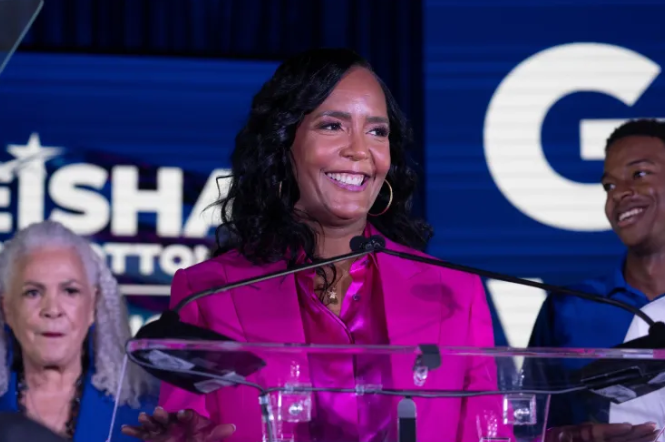
The election of Keisha Lance Bottoms as Georgia’s next governor is significant for more than its historic political implications. It could also matter for the future of guaranteed income in the United States.
Before entering the governor’s race, Bottoms served as Mayor of Atlanta, where she helped establish the I.M.P.A.C.T. guaranteed income pilot. The programme provided 300 low-income residents with $500 every month, without restrictions on how they could spend the money.
The evaluation offers an important reminder of what direct cash support can achieve. Participants were more than twice as likely as the comparison group to afford an unexpected $400 expense and were 25% less likely to carry medical debt. Employment rates remained unchanged, while housing stability improved.
These findings challenge a familiar assumption: that giving people money discourages them from working. Instead, income security can give people room to manage unexpected expenses, reduce financial stress and make more stable decisions.
But the significance of Bottoms’ election goes beyond the pilot itself.
As governor, she will have the power to protect locally funded guaranteed income initiatives from potential state-level restrictions. This matters because some states, including Texas, Iowa and Arkansas, have moved to restrict local governments from operating their own guaranteed income programmes.
Georgia’s political landscape will still impose limits. Republicans retain control of the state Senate, making a statewide universal basic income unlikely in the immediate future. Bottoms cannot simply introduce a universal payment across Georgia.
Nevertheless, protecting the ability of cities, counties and community organisations to experiment with direct cash support is an important step.
There is also a distinction worth making. Guaranteed income pilots generally target specific groups experiencing economic hardship, while Universal Basic Income (UBI) is designed to be regular, unconditional and universal. They are not the same policy, but targeted pilots can help build evidence, public understanding and political support for broader income security.
The bigger lesson is that basic income is not only an economic policy debate. It is also a question of political will.
We need leaders who are willing to question outdated assumptions about poverty, trust people to make decisions about their own lives, and recognise that economic security is a foundation for participation in society.
Temporary pilots are valuable, but the long-term ambition should be to move beyond isolated experiments towards systems that guarantee everyone a secure income floor.
Read the full article: https://www.newsweek.com/keisha-lance-bottoms-universal-basic-income-georgia-12708938